

If you're new to coaching or looking to level up your team’s performance in 2026, you’re not alone in feeling overwhelmed by the sheer amount of gear available. From "magic" bands to high-tech timing gates, the options are endless. But here’s the truth: explosive speed isn’t built by gadgets; it’s built by targeted resistance and perfected mechanics.
The right gear simply allows you to apply those principles more effectively. Whether you’re coaching youth football, elite rugby, or track sprinters, having a toolkit that challenges an athlete's fast-twitch muscle fibres is non-negotiable.
In this guide, we’ve rounded up 15 top-rated pieces of speed training gear that actually deliver results. Let’s dive in! 🚀
1. Speed Agility Ladders
The bread and butter of any speed program. Ladders aren't necessarily for "top-end" speed, but they are unmatched for developing neuromuscular coordination and quick feet.
- Best for: Footwork, rhythm, and body control.
- Coach Tip: Focus on "quiet feet": if the ladder is moving, the athlete isn't precise enough.
- Check out: Our Eco Play Speed Agility Ladder Set for a complete starter kit.
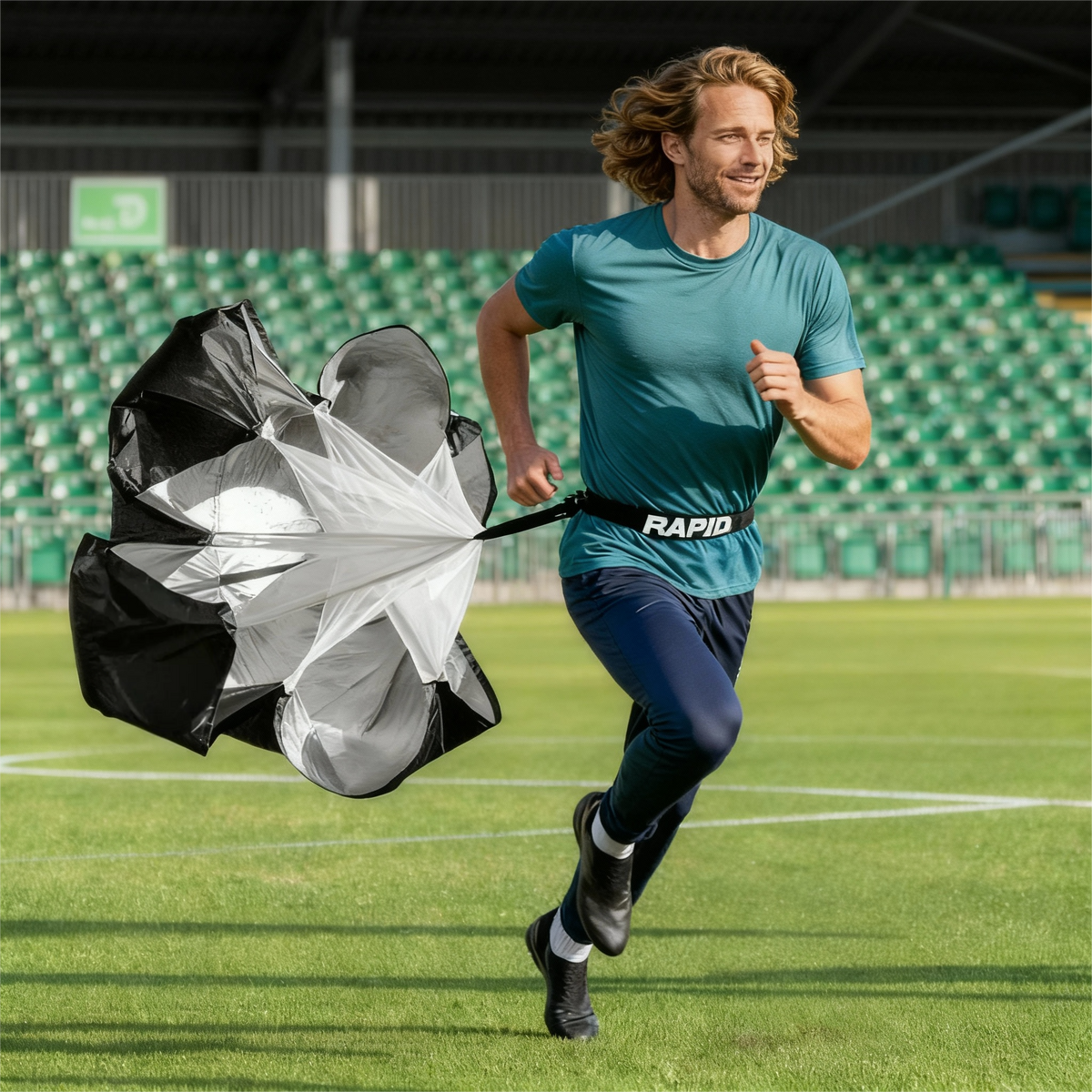
2. Speed Resistance Parachutes
If you want to build that "second gear" in your sprinters, parachutes are essential. They provide dynamic resistance: the faster the athlete runs, the harder the chute pulls.
- Key Benefit: Improves stride length and builds specific strength in the glutes and hamstrings.
- Measurement: Aim for 20-40 meter sprints with the chute.
- Get it here: FH Speed Training Power Chute.
3. Mini Agility Hurdles
Nothing builds explosive hip power like plyometric work over mini hurdles. They force athletes to pick up their knees and maintain a high turnover.
- Height: Usually 6, 9, or 12 inches.
- Drill Idea: Set 5-6 hurdles 1 meter apart for rapid-fire "pogo" jumps or high-knee sprints.
4. Non-Slip Flat Disc Markers
Traditional cones are great, but flat discs are safer for high-speed "cutting" drills because they don't trip athletes up if they step on them.
- Usage: Perfect for outlining "Z-drills" or "T-tests."
- Pros: Low profile and highly visible.
- View Product: Agility Sports Non-Slip Flat Disc Markers.
5. Speed Resistor Harnesses
A speed harness allows for "partner-resisted" sprinting. This is one of the most effective ways to teach proper acceleration mechanics (leaning forward at a 45-degree angle).
- Setup: One athlete sprints while the partner provides steady tension from behind.
- Actionable Detail: Keep the resistance at about 10-15% of the athlete's body weight to avoid ruining their form.
6. Resistance Bands (Power Loops)
Versatile and portable, resistance bands can be used for "monster walks" to activate the glutes or attached to a fence for resisted starts.
- Why they work: They provide constant tension that traditional weights don't.
- Browse: Rapid Sports Resistance Band Collection.
7. Weighted Speed Sleds
Sled training is the gold standard for building raw power. Pushing or pulling a sled mimics the drive phase of a sprint better than almost any other exercise.
- Focus on: Heavy sleds for strength (starts), light sleds for speed (acceleration).
8. Leg Speed Bands (Kinetic Bands)
Worn just above the knees, these bands allow for a full range of motion while adding resistance to every stride.
- Expert Advice: Great for lateral agility drills and building the hip flexor strength needed for high-speed knee drive.
9. Professional Speed Ropes
Don't overlook the humble skipping rope. It’s the ultimate tool for building "elasticity" in the ankles, which translates to shorter ground contact time.
- Goal: Aim for 2-3 sets of 1-minute high-speed intervals.
- Try this: FH Pro Skipping Rope.
10. Medicine Balls (2kg - 5kg)
Explosive speed starts in the core. Throwing a medicine ball horizontally (chest pass) or vertically (overhead toss) trains the body to transfer power from the ground up through the limbs.
11. Reaction Balls
These multi-sided balls bounce unpredictably. They are fantastic for training reactive agility and hand-eye coordination.
- Drill: Drop the ball from waist height and try to catch it after one bounce.
12. Hexagon Agility Rings
Think of these as a modular agility ladder. You can clip them together in different shapes to create unique footwork patterns.
- Benefit: They stay flat on the ground and don't tangle like fabric ladders.
13. Adjustable Weighted Vests
Adding 5-10% of body weight via a vest makes every jump and sprint more demanding.
- Safety Warning: Ensure the vest is snug to avoid it bouncing and causing back strain.
14. Electronic Timing Gates
If you want to be serious about speed, you have to measure it. Stopwatches are prone to human error. Timing gates provide laser-accurate data to track progress over weeks and months.
15. All-in-One Agility Kits
For the traveling coach, a kit that bundles ladders, cones, and hurdles is a lifesaver. It keeps everything organized and ready for the pitch.
- Ready-to-Go: FH Speed & Agility Athlete Training Set.
Common Speed Training Mistakes to Avoid
- Over-training: More isn't always better. Speed training is high-intensity for the central nervous system. 2-3 quality sessions a week are plenty.
- Bad Form under Load: If an athlete’s technique breaks down during a resisted sprint (e.g., they start "hunched over"), reduce the resistance immediately.
- Ignoring Rest: You cannot train "speed" while fatigued. Rest periods should be 1 minute for every 10 meters sprinted.
Frequently Asked Questions (FAQ)
Q: At what age should athletes start using speed gear? A: Basic tools like ladders and light cones are great for kids as young as 6-8 to build coordination. Resistance gear like sleds and parachutes should usually wait until they are 12-14 and have a solid strength base.
Q: Can I use a speed parachute on artificial turf? A: Absolutely! Parachutes work on any surface. Just ensure there are no obstacles (like goal posts) that the cord could catch on.
Q: How often should I replace my agility ladder? A: Most professional-grade ladders made of nylon and plastic will last 2-3 years with heavy team use. Store them dry to avoid the nylon rotting.
Final Steps: Building Your Explosive Athlete
Building speed is a journey, not a sprint (pun intended!). Start with the basics: the ladder and the cones: and gradually introduce resistance tools like parachutes and harnesses as your athletes get stronger.
Ready to start training? Check out our Speed and Agility Collection to grab your gear today.
Go get those gains! 🏃💨


