

If you've ever watched your athletes run drills individually and thought, "there's got to be a better way," you're not alone. Setting up a proper agility circuit transforms scattered training into a systematic speed lab where every athlete stays moving, engaged, and improving.
The best part? You don't need a massive budget or warehouse-sized facility. With the right training equipment for coaches and a smart layout, you can build a circuit that rivals what professional teams use.
Why Circuits Beat Traditional Drill Sessions
Here's the thing about running drills one at a time: athletes spend more time standing around than actually training. A well-designed circuit keeps everyone moving through stations, maximizing contact time with the training equipment while building the conditioning and mental toughness that separates good teams from great ones.
Circuits deliver multiple wins simultaneously:
- Athletes get more quality reps in less total time
- Your training density skyrockets (more work, less standing)
- Natural competition emerges as athletes rotate through stations
- You can coach multiple movement patterns in one session
- Metabolic conditioning happens automatically alongside skill work
Think of your circuit as a speed assembly line where each station builds a specific quality your team needs.
Planning Your Circuit Layout: Start Here
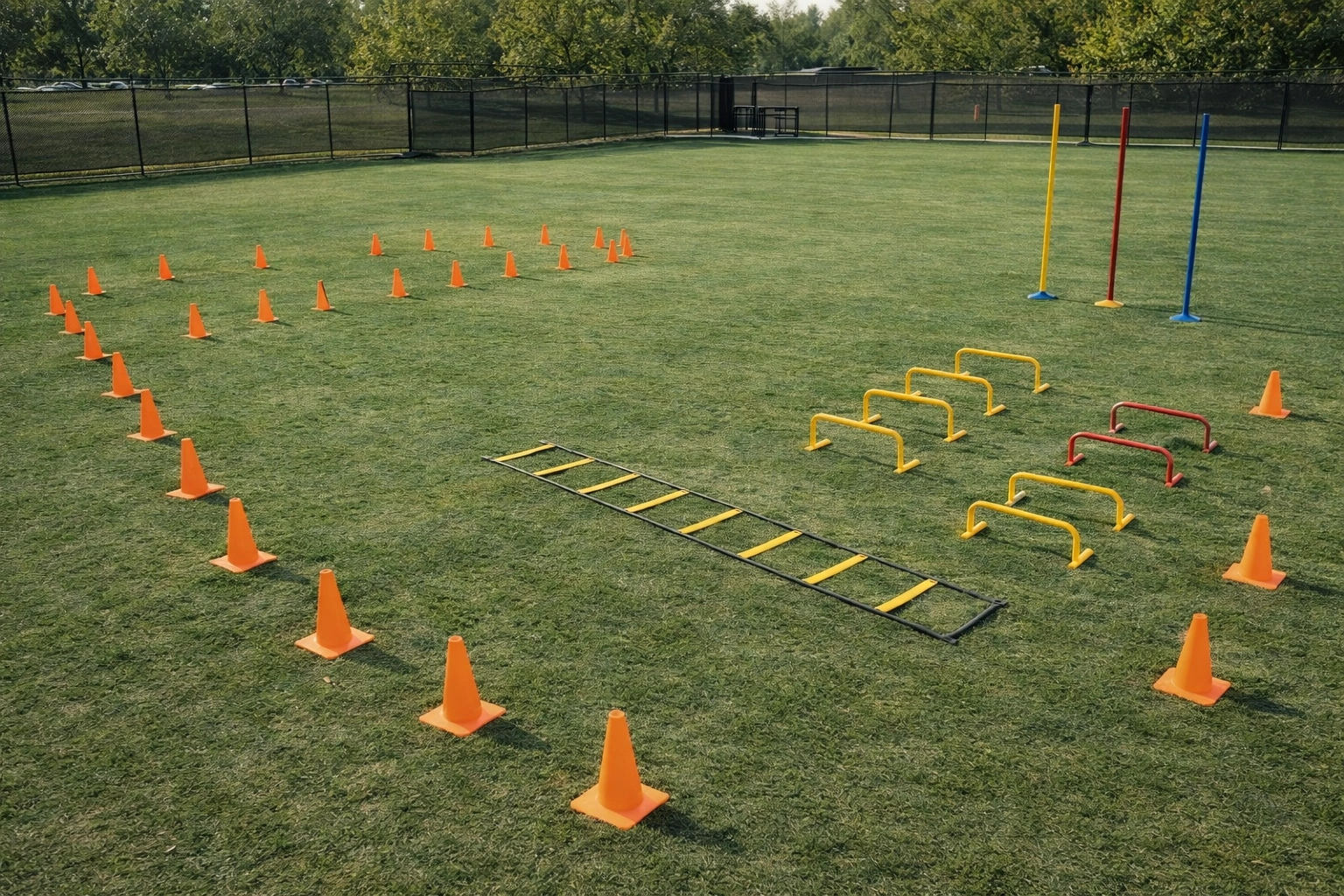
Before you buy a single cone, map out your space. Walk your training area and identify natural flow patterns. You want athletes moving smoothly from station to station without crossing paths or creating traffic jams.
Your ideal layout considerations:
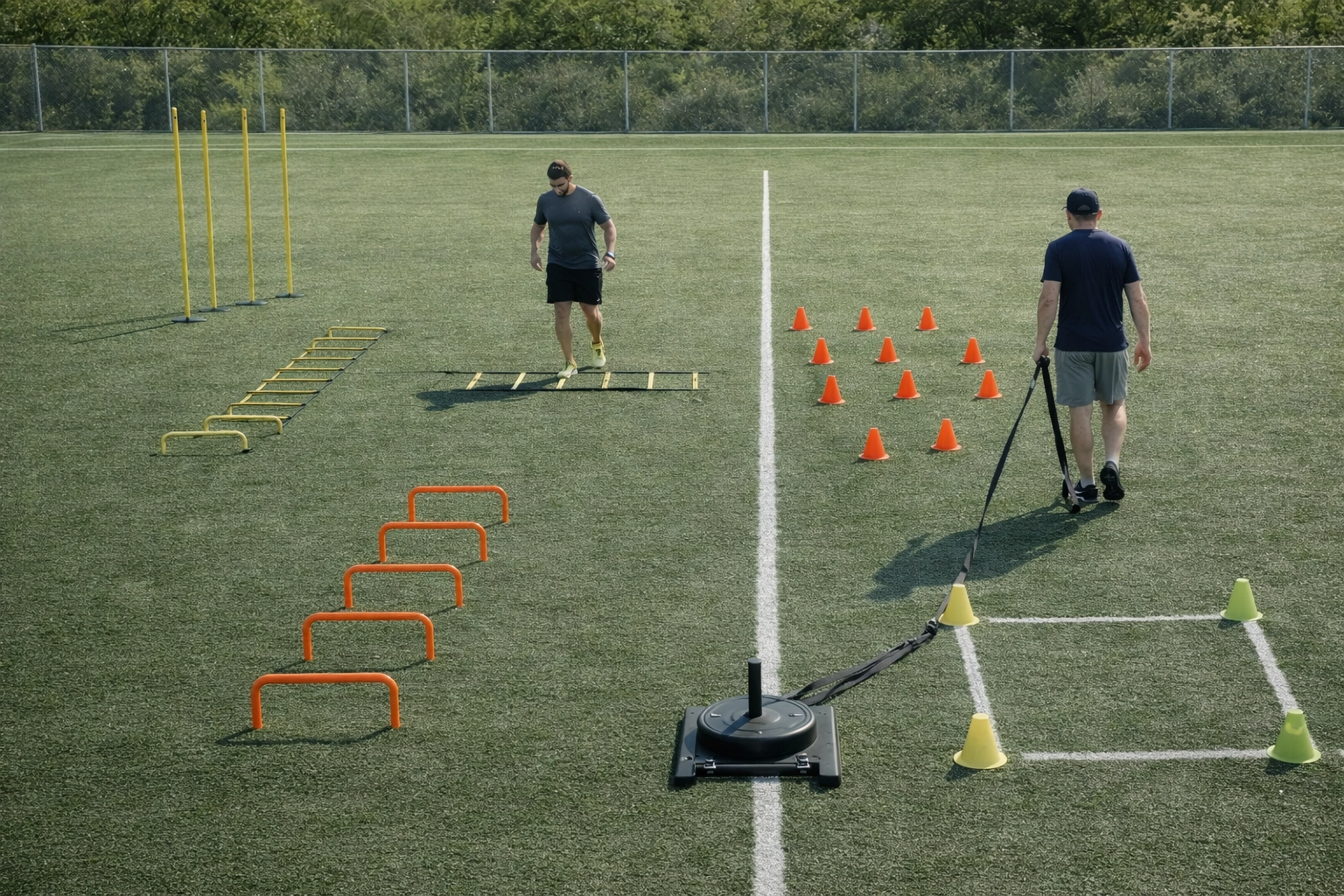
- 20-30 feet minimum between stations for safety buffers
- Clear sight lines so you can monitor all stations from a central position
- Logical progression that alternates high-intensity and moderate-intensity stations
- Equipment storage access that doesn't interrupt athlete flow
- Entry and exit points that prevent bottlenecks
Most coaches find success with either a rectangular loop pattern (athletes move clockwise around the perimeter) or a hub-and-spoke design (stations radiate from a central starting point). Pick what fits your space and stick with it: consistency helps athletes learn the flow.
The Essential Training Equipment for Coaches
You don't need everything, but you need the right things. Here's your circuit starter kit that covers 90% of what great agility training requires:
Speed and footwork stations:
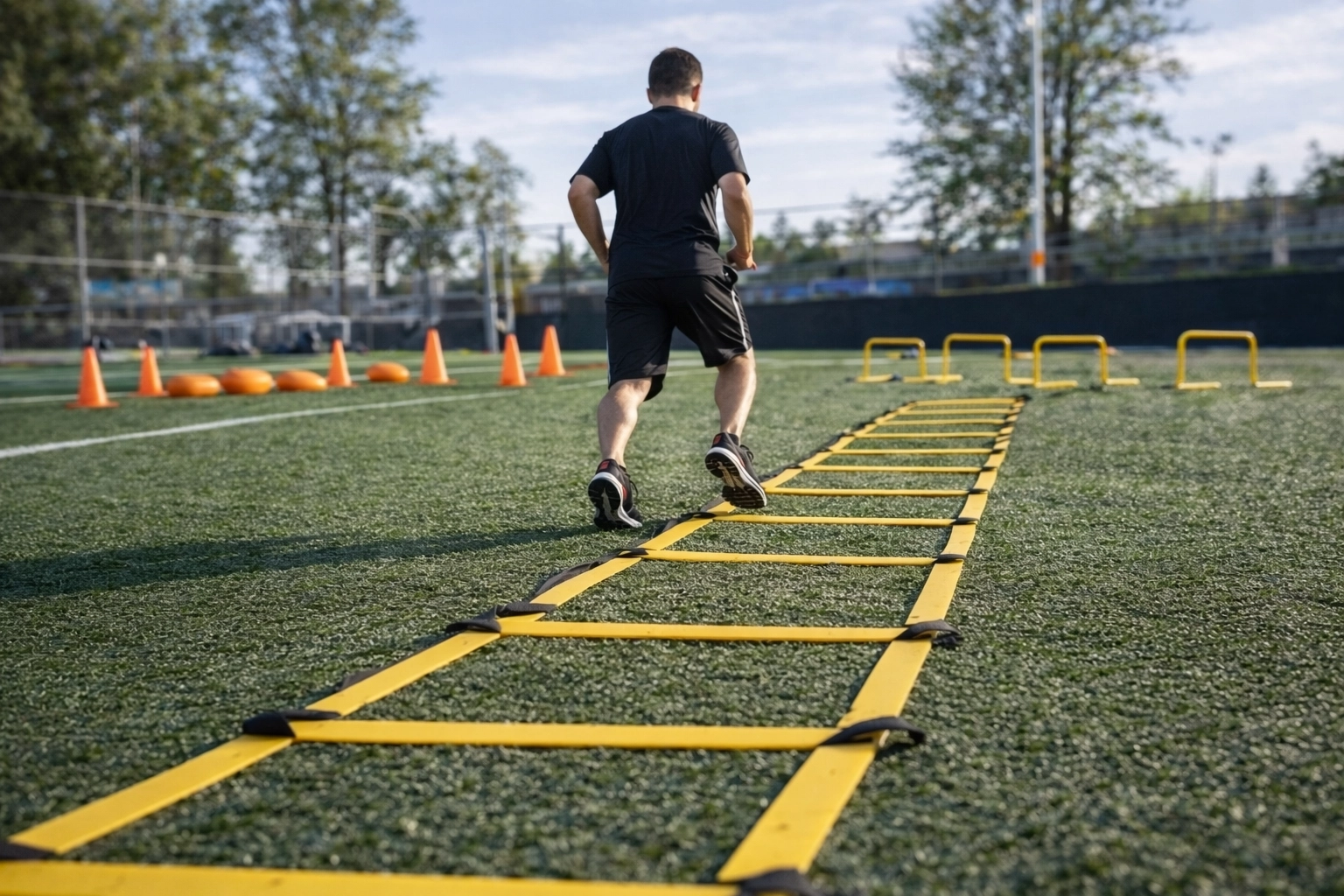
- Agility ladder (15-20 feet works for most drills)
- 20-30 training cones in bright colors
- Speed hurdles (6-12 inches adjustable height)
- Agility poles or vertical markers
Resistance and power stations:
- Resistance bands or harness system
- Medicine balls (4-10 pounds depending on age)
- Speed sled or resistance parachute
- Plyometric boxes or markers
Tracking and organization:
- Stopwatch or timer with interval function
- Whistle for clear station transitions
- Station cards showing the drill and rep count
- Clipboard for tracking athlete performance
Pro tip: Start with cones, ladders, and hurdles if budget is tight. These three pieces of training equipment cover 70% of effective agility work. You can always add resistance tools later as your program grows.
Your Six-Station Circuit Breakdown
Let's build a circuit that hits every agility component your team needs. Each station targets different movement qualities while keeping athletes in constant motion.
Station 1: Linear Acceleration (Speed Development)
Set up a 20-meter sprint lane with cones marking start and finish. Athletes perform 3-4 maximal effort sprints, walking back to recover. This station develops pure speed and builds the explosive first-step power essential for all sports.
Station 2: Ladder Footwork (Quickness)
Place your agility ladder flat on the ground. Athletes run through patterns: two feet in each box, lateral shuffles, or Ickey shuffle patterns. Focus here is rapid foot turnover and coordination. Keep the pace high with 20-30 seconds of continuous work.
Station 3: Cone Weave (Change of Direction)
Arrange 5-6 cones in a straight line, 5 feet apart. Athletes sprint and weave through the cones, focusing on sharp cuts and acceleration out of each turn. This builds the lateral power and deceleration control that prevent injuries during games.
Station 4: Hurdle Hops (Plyometric Power)
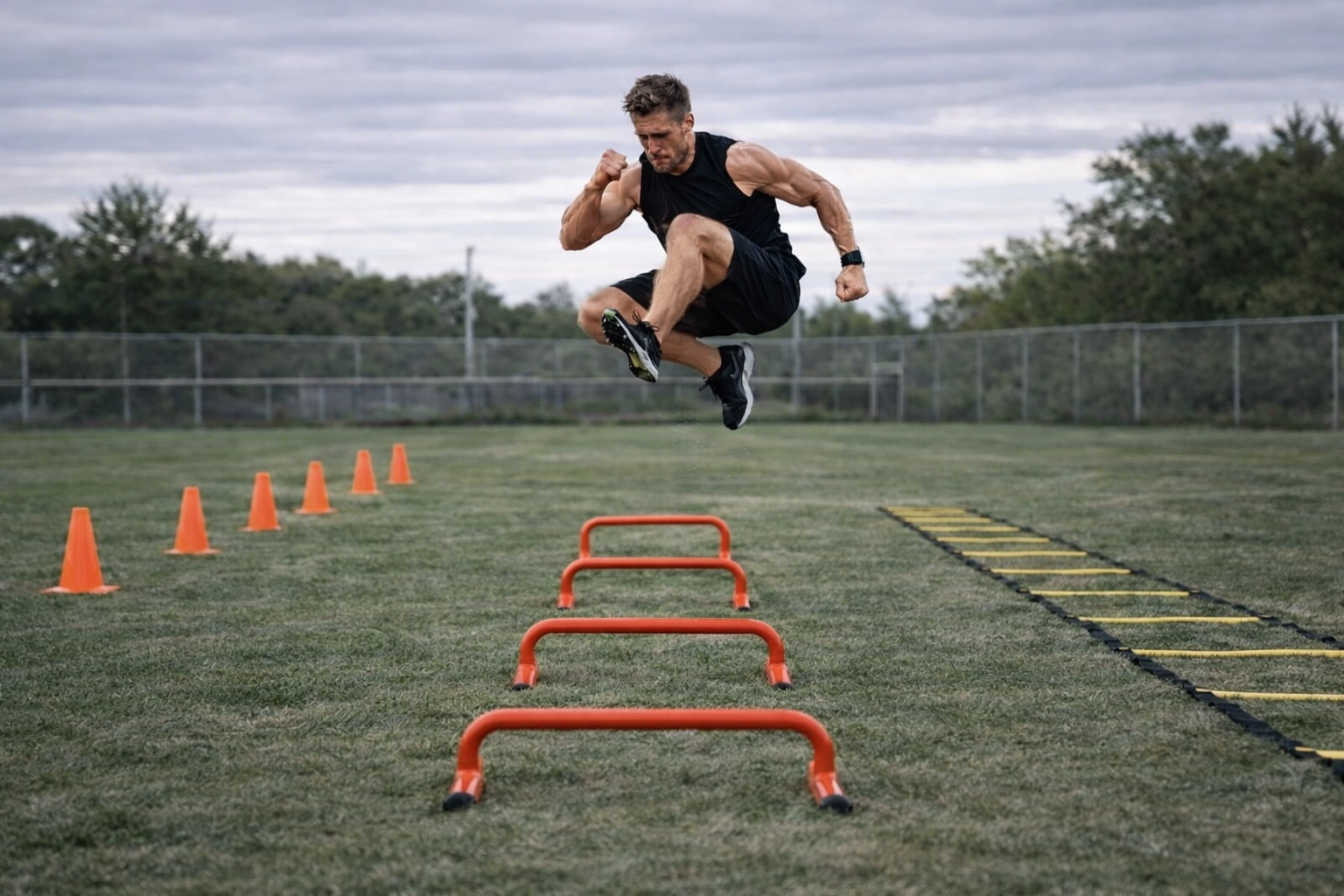
Set up 6-8 low hurdles in a row. Athletes perform continuous two-footed hops over each hurdle, emphasizing quick ground contact and explosive leg drive. This station develops the stretch-shortening cycle that makes athletes springy and powerful.
Station 5: Resistance Runs (Strength-Speed)
Using a speed sled, resistance band, or parachute, athletes perform 15-20 meter loaded sprints. The resistance builds the specific strength needed to accelerate faster when unloaded. Keep resistance moderate: athletes should maintain good form and only slow about 10-15%.
Station 6: Multi-Directional Movement (Game-Speed Agility)
Create a box pattern with cones at each corner (10-15 feet apart). Athletes sprint forward, shuffle left, backpedal, shuffle right, and sprint forward again. This mirrors the chaotic movement patterns they'll face in competition.
Dialing In Your Work and Rest Intervals
Here's where most coaches get circuits wrong: they either work athletes too long (form breaks down) or rest them too much (intensity drops). Your intervals depend on your training goal.
For power and speed development:
- Work period: 10-20 seconds maximum effort
- Rest period: 60-90 seconds between stations
- Sets: 3-4 rounds through the entire circuit
- Focus: Explosive quality on every single rep
For conditioning and mental toughness:
- Work period: 30-45 seconds continuous effort
- Rest period: 15-30 seconds between stations
- Sets: 2-3 rounds through the entire circuit
- Focus: Maintaining technique under fatigue
Start conservative. It's better to have athletes finish strong than completely gassed at station three. You can always add intensity next session once you see how your team handles the volume.
Use a timer with audible signals for station changes. This keeps the circuit flowing smoothly and removes guesswork about when to rotate.
Running Your First Session: The Game Plan
Don't just throw athletes into the circuit cold. Your first session should feel like a guided tour, not a punishment.
Your first-session checklist:
- Warm-up thoroughly (10-12 minutes of dynamic movement)
- Walk the circuit together, demonstrating each station
- Practice transitions with a dry run at 50% intensity
- Run one full round focusing purely on technique
- Add intensity gradually on rounds 2-3
- Cool down and debrief what felt good and what needs adjustment
Watch for athletes who struggle with specific stations. These reveal gaps you can address in individual work. The circuit naturally exposes weaknesses while building overall athleticism.
Keep initial sessions shorter than you think necessary. Athletes adapt to circuit training over 3-4 weeks. Early sessions build the mental map and movement patterns. Later sessions can push intensity harder once the foundation exists.
Common Mistakes That Kill Circuit Effectiveness
Even experienced coaches fall into these traps when building circuits. Avoid them and you'll see faster results:
Mistake #1: Too many stations with too many athletes. More isn't better. Six well-designed stations with 3-4 athletes per station beats twelve stations with overcrowding. Athletes need enough work time to improve, not rushed reps.
Mistake #2: Random exercise selection. Your stations should build on each other logically. Don't put two high-intensity explosive stations back-to-back unless fatigue management is your specific goal.
Mistake #3: Ignoring bilateral balance. If station three involves cuts to the right, make sure athletes work both directions either at that station or elsewhere in the circuit. Asymmetrical training creates asymmetrical athletes.
Mistake #4: Skipping the coaching. Just because it's a circuit doesn't mean you stand back and let it run. Move station to station, giving specific feedback and technique cues. Your coaching attention multiplies the circuit's effectiveness.
Mistake #5: No progression plan. Week one should not look identical to week six. Add complexity, increase volume slightly, or sharpen intensity as athletes adapt. Progressive overload applies to agility training just like strength work.
Your Next Steps
Start simple. Pick four of the six stations above and set them up this week. Run your team through one round at moderate intensity to learn the flow. Add complexity from there based on what you see.
The training equipment for coaches you need is probably sitting in your storage closet right now. Grab those cones, that ladder, and some hurdles. Map out your space. Set your timer.
Your speed lab doesn't need to be fancy: it just needs to be functional and consistent. The teams that win aren't always the most talented. They're the ones who train smarter, move better, and squeeze every second of practice for maximum development.
Build your circuit. Run it consistently. Watch your athletes transform into faster, more agile competitors who dominate when it matters most.
Want more guidance on agility training fundamentals? Check out our complete guide to getting faster and more agile to master the basics before building complex circuits.


