

You're not alone if you think agility training requires expensive equipment or a fancy gym membership. The truth is, some of the most effective agility workouts can be done right in your living room using nothing but your bodyweight and a few household items. Whether you're a complete beginner or an athlete looking to supplement your training, this guide will show you exactly how to build speed, coordination, and quick feet without spending a penny on equipment.
Why DIY Agility Training Actually Works
Agility training is all about teaching your body to change direction quickly while maintaining control and balance. Your muscles don't know the difference between a $200 agility ladder and an imaginary line on your carpet – they just respond to the movement patterns you practice.
Here's what makes DIY agility training so effective:
• Consistency beats complexity – You're more likely to train regularly when you can do it anywhere • Focus on fundamentals – Without fancy equipment, you concentrate on proper movement mechanics • Progressive overload – You can increase intensity simply by moving faster or adding more repetitions • Functional movement – These exercises translate directly to real-world athletic performance
Research shows that just 20 minutes of focused agility training can significantly improve your foot speed, reaction time, and coordination in as little as one week of consistent practice.
Essential Equipment-Free Agility Exercises
1. The Side Shuffle Series
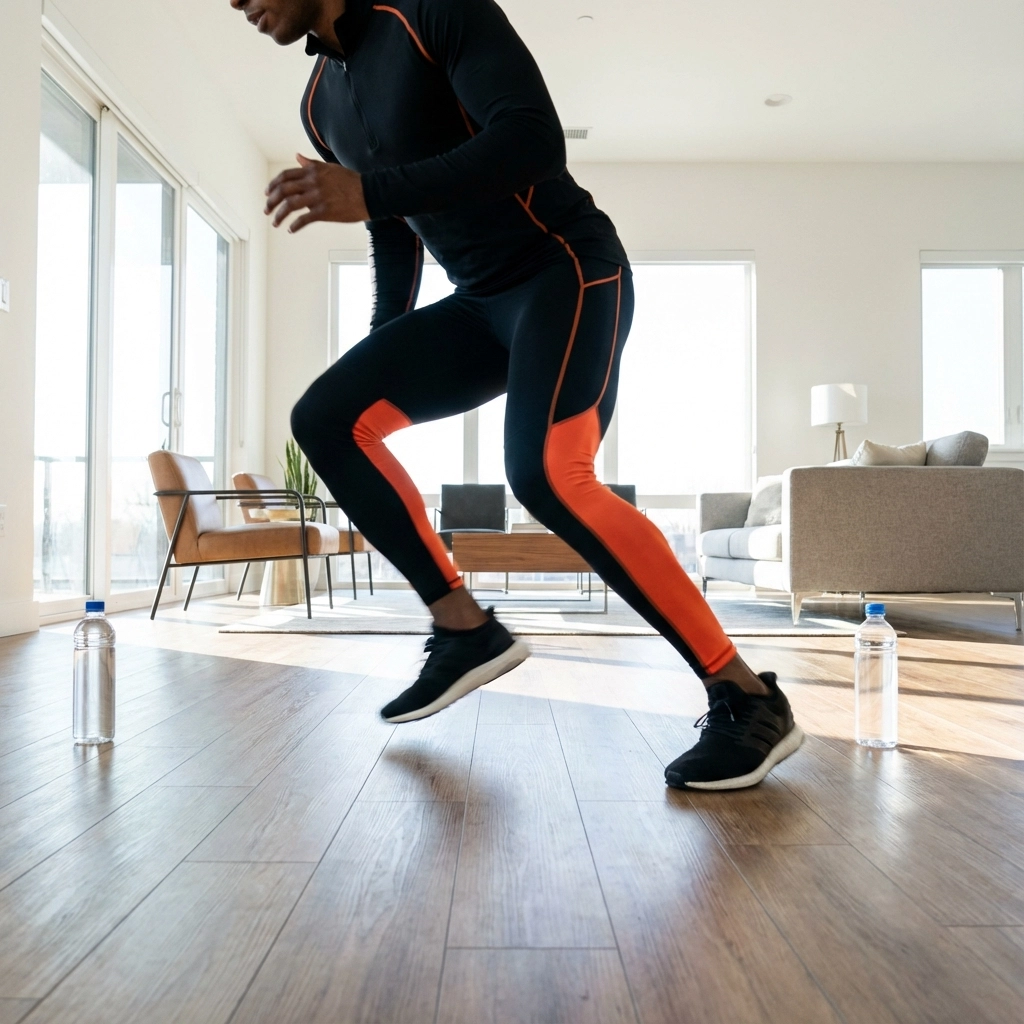
The side shuffle is your foundation movement for lateral agility. Here's how to master it:
Basic Side Shuffle: • Place two household items (water bottles, books, or shoes) about 15 steps apart • Stand next to one marker with your body facing perpendicular to the imaginary line between them • Adopt an athletic stance: knees slightly bent, weight on the balls of your feet • Shuffle side-to-side between markers without crossing your feet • Keep your hips low and maintain the athletic stance throughout
Progression variations: • Speed shuffle: Focus on moving your feet as quickly as possible • Resistance shuffle: Add arm swings or hold light household items • Pattern shuffle: Create different directional patterns (L-shapes, diamonds)
2. High-Knee Power Drills
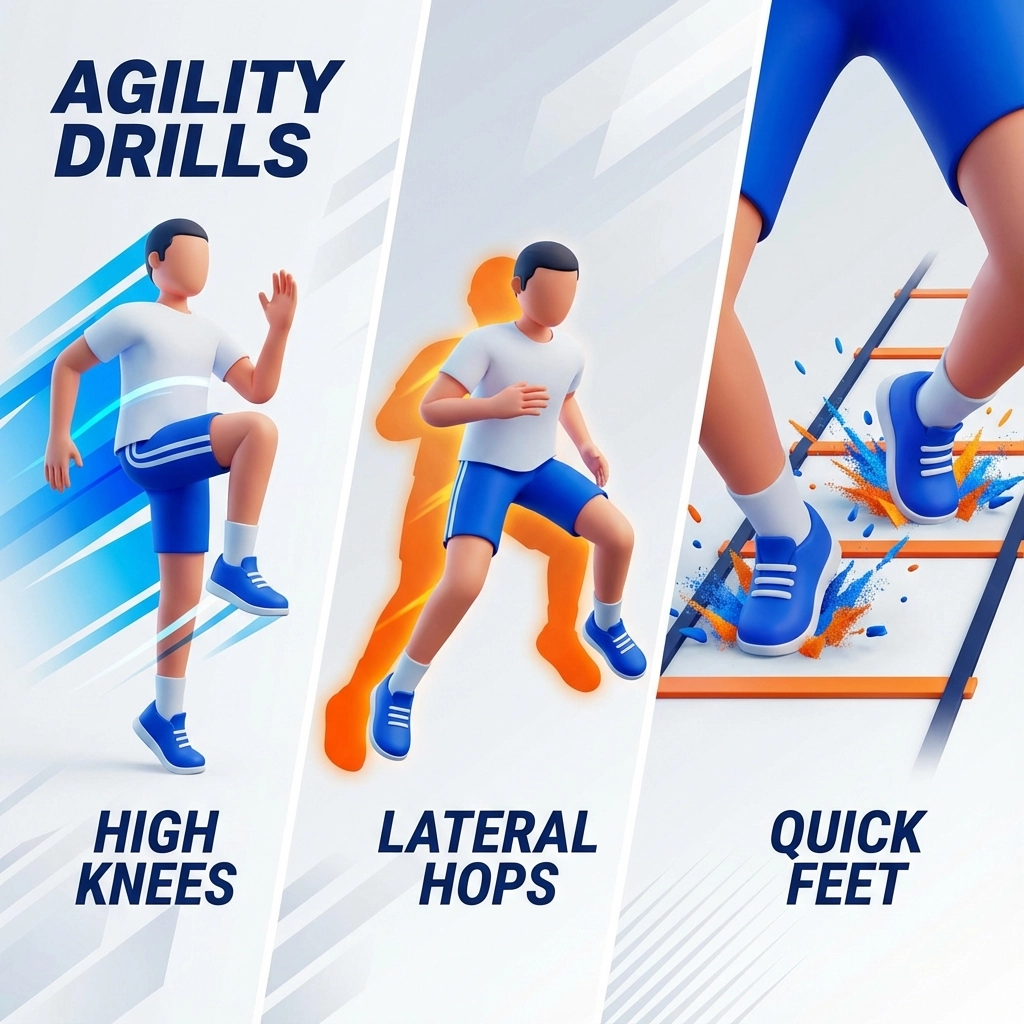
These drills develop the explosive leg power essential for quick directional changes:
Standard High Knees: • Run in place, driving your knees up toward your chest • Aim for 90-degree angles at the hip and knee • Land on the balls of your feet • Keep your torso upright and arms pumping
Advanced variations: • High knees with direction changes: Add 90-degree turns every 10 steps • Single-leg high knees: Alternate between single-leg and double-leg patterns • High knees to sprint: Transition from high knees into a short sprint
3. Lateral Hop Progressions
Build single-leg strength and stability with these lateral movements:
Single-Leg Lateral Hops: • Start on your right leg, hop 2-3 feet to the left • Land softly on your left leg, pause for 1 second • Hop back to the right, landing on your right leg • Focus on controlled landings and quick takeoffs
Double-Leg Lateral Hops: • Use both feet to hop side-to-side • Land with both feet simultaneously • Keep hops low and quick rather than high and slow
4. Quick Feet Patterns
These drills enhance foot speed and coordination:
In-Place Quick Feet: • Keep feet shoulder-width apart • Rapidly tap your feet up and down without moving forward • Stay light on the balls of your feet • Aim for 20-30 taps in 10 seconds
Forward-Back Quick Feet: • Take small, rapid steps forward for 5 yards • Immediately reverse and take small steps backward • Keep your center of gravity low throughout
Sample Workout Routines
The 20-Minute Beginner Circuit
Perfect for those new to agility training. Repeat this circuit 2-3 times with 1-2 minutes rest between rounds:
Round 1: Foundation Building (5 minutes) • 20 Walking lunges (10 per leg) - builds leg strength • 30 seconds side shuffles - develops lateral movement • 10 push-ups - upper body stability • 30 seconds high knees - explosive power • 10 bodyweight squats - lower body strength
Round 2: Agility Focus (5 minutes) • 45 seconds lateral hops (spot to spot) • 20 reverse lunges (10 per leg) • 45 seconds quick feet in place • 15 triceps dips using a chair • 30 seconds jumping jacks
Round 3: Power Development (5 minutes) • 25 squat jumps - explosive leg power • 45 seconds imaginary cone runs (create a square pattern) • 30-second plank with arm reaches • 20 elevated bridges using your couch • 45 seconds of mixed movement patterns
The 15-Minute Advanced Challenge
For experienced athletes or those ready to increase intensity:
Circuit A: Speed Focus (7 minutes) • 3 x 30 seconds maximum speed side shuffles • 3 x 20 single-leg lateral hops (each leg) • 3 x 15 seconds quick feet patterns • 30 seconds rest between exercises
Circuit B: Power & Coordination (8 minutes) • 4 x 10 explosive squat jumps • 4 x 30 seconds directional high knees • 4 x 20 alternating lateral lunges • 45 seconds rest between exercises
Setting Up Your DIY Training Space
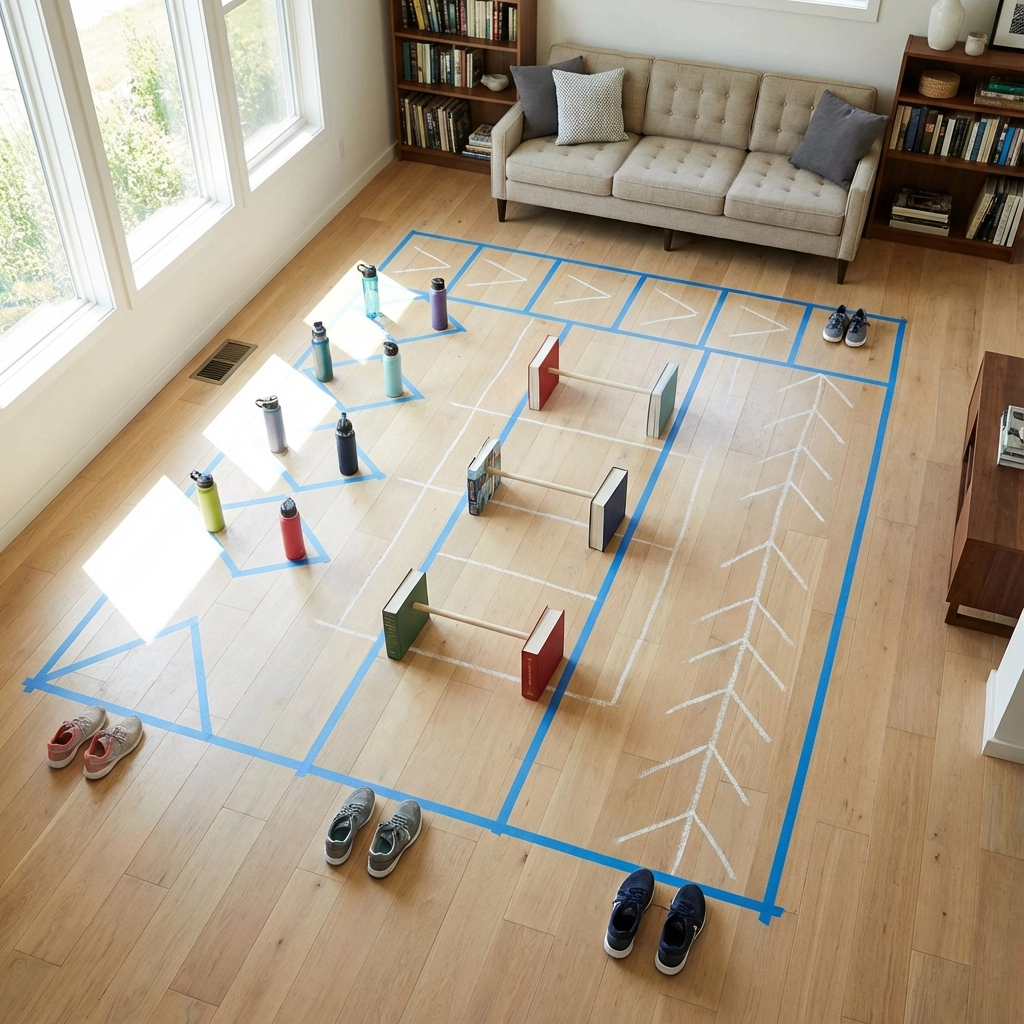
You need surprisingly little room to get an effective agility workout. Here's how to optimize your space:
Minimum Space Requirements: • Length: 9-12 feet of open floor • Width: 6-8 feet of clearance • Height: Standard ceiling height (8 feet minimum)
Creating Markers Without Equipment: • Cone substitutes: Water bottles, books, shoes, or toys • Line markers: Use carpet seams, tile lines, or tape • Boundaries: Furniture edges or wall corners • Targets: Pillows, towels, or paper plates
Safety Setup Checklist: • Remove breakable objects from the training area • Ensure adequate lighting • Wear appropriate athletic shoes with good grip • Keep a water bottle nearby for hydration
Common Mistakes That Slow Your Progress
Avoid these pitfalls that can limit your improvement:
Technique Errors: • Going too high instead of quick: Focus on rapid, low movements rather than high jumps • Crossing feet during shuffles: Keep feet parallel and avoid crossing over • Landing heavily: Always aim for soft, controlled landings • Neglecting arm movement: Your arms help with balance and momentum
Programming Mistakes: • Training every day: Allow 48 hours between intense sessions for recovery • Skipping warm-ups: Always start with 2-3 minutes of light movement • Ignoring progression: Gradually increase intensity rather than jumping to advanced moves • Focusing only on speed: Build proper movement patterns before emphasizing quickness
Mindset Traps: • Comparing to others: Focus on your own improvement rate • Expecting instant results: Noticeable improvements typically appear after 7-10 consistent sessions • Overcomplicating movements: Master the basics before adding complex patterns
Progressive Training Plan
Week 1-2: Foundation Phase
• Train 3 times per week for 15-20 minutes • Focus on proper form and basic movement patterns • Use moderate intensity (60-70% effort) • Master side shuffles, high knees, and basic hops
Week 3-4: Development Phase
• Increase to 4 training sessions per week • Add directional changes and combination movements • Boost intensity to 70-80% effort • Introduce quick feet patterns and power exercises
Week 5-6: Performance Phase
• Maintain 4 sessions per week, increase duration to 25-30 minutes • Focus on maximum speed and complex movement patterns • Train at 80-90% effort during work intervals • Add sport-specific movement patterns
Measuring Your Progress: • Week 1: Time how long it takes to complete 20 side shuffles • Week 3: Retest and aim for 10-20% improvement • Week 6: Test again – most people see 25-40% improvement by this point
Your Next Steps to Agility Success
Ready to transform your speed and coordination? Here's your action plan:
This Week:
- Clear your training space and gather household markers
- Schedule three 20-minute sessions in your calendar
- Start with the beginner circuit regardless of your current fitness level
- Track your first session – note how many rounds you complete
Next Week:
- Add one movement variation to each exercise
- Increase your effort level by 10-15%
- Film yourself performing one exercise to check your form
- Measure improvement by timing a specific drill
Remember, the best agility training program is the one you'll actually do consistently. Start simple, stay consistent, and watch as your speed and coordination improve week after week. Your athletic performance will thank you, and you'll have built these skills using nothing but dedication and creativity.
For those ready to take their training to the next level with professional equipment, explore our complete agility training collection for when you're ready to expand beyond DIY methods. But for now, you have everything you need to get started right where you are.


