
Reactive Agility vs Planned Drills: Which Gets Your Team Match-Ready Faster in 2026?
by Paul Harwood
·
If you're like most coaches, you've probably found yourself in the middle of training wondering: Should I be running more cone drills or focusing on reactive exercises? You're not alone. This debate has been going on for years, and here's the honest truth, it's not actually an either-or situation.
Let's break down what really gets your team match-ready faster, what equipment you need, and how to combine both approaches without overthinking it.
What Are Planned Drills, Anyway?
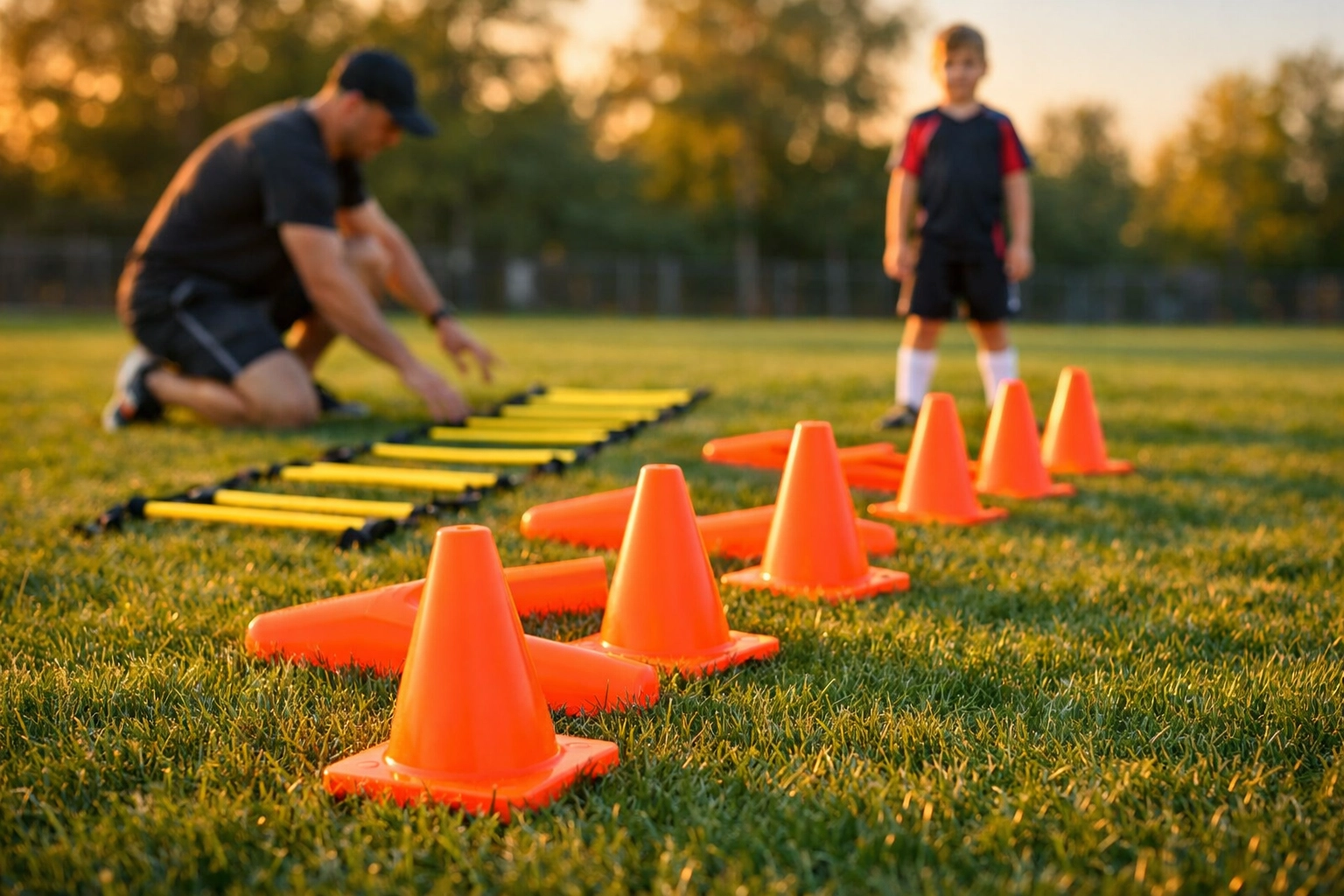
Think of planned drills like choreography. Your athletes know exactly where they're going before they start moving. Classic examples include:
- Zigzag cone runs through a fixed pattern
- Ladder drills with predetermined foot placements
- T-drills or 5-10-5 shuttle runs with set distances
- Figure-8 patterns around cones or poles
These drills are fantastic for building the physical foundation your team needs. Research shows that pre-planned change-of-direction work produces significant improvements in agility speed within 6-8 weeks when you run them twice weekly. Plus, athletes generally enjoy them more than endless conditioning, which helps with attendance and effort levels.
What planned drills develop:
- Eccentric braking capacity (stopping power)
- Explosive re-acceleration
- Proper cutting mechanics
- Neuromuscular coordination
- Baseline speed and footwork
So What's Reactive Agility Then?
Now here's where it gets real. Reactive agility introduces unpredictability, just like actual matches. Your athletes have to read, decide, and respond in real-time.
Reactive training looks like:
- Coach signals that trigger left/right movement
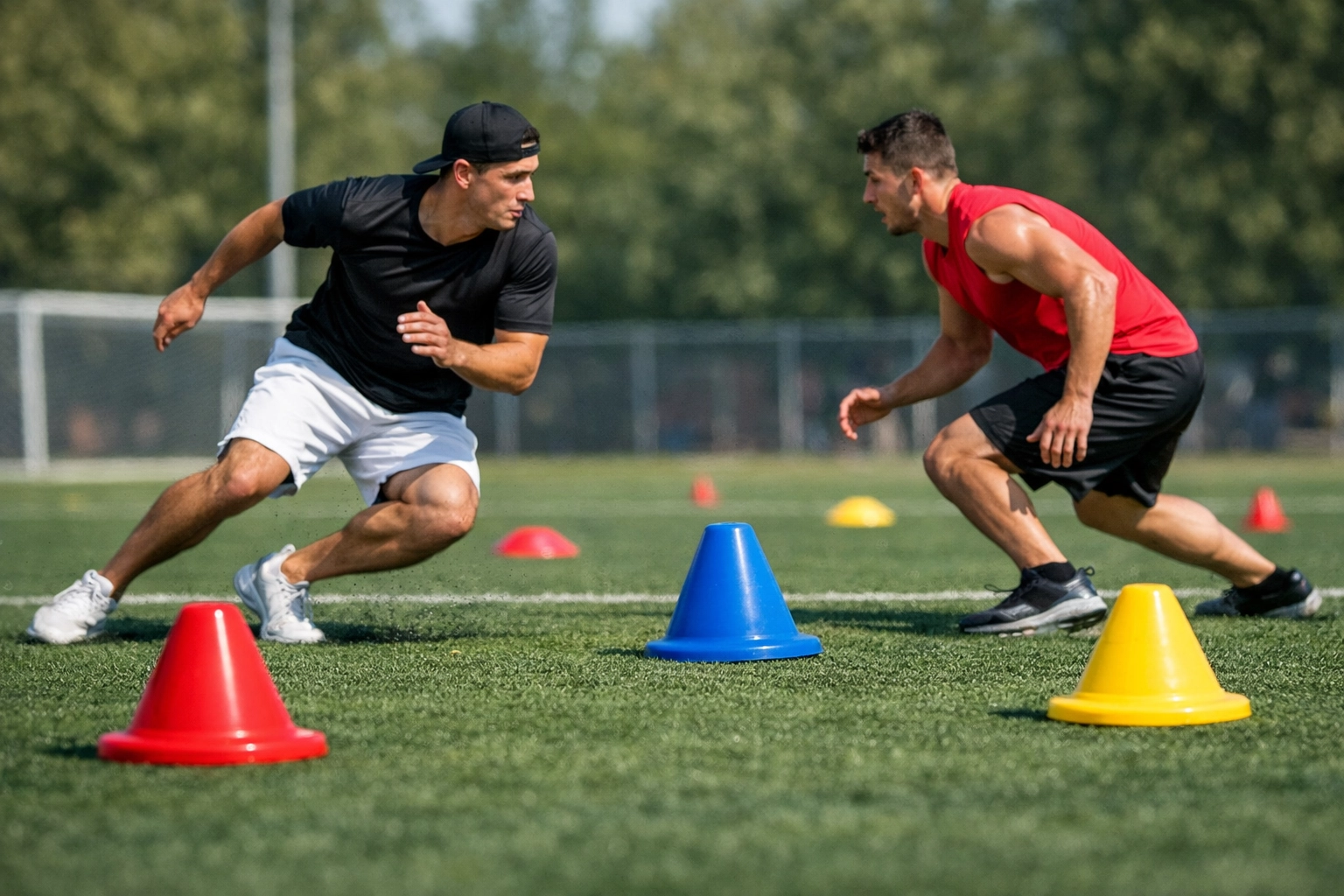
- Mirroring a partner's unpredictable movements
- Reacting to colored cones or verbal calls
- Small-sided games with variable scenarios
- Chase-and-evade drills with live opponents
The key difference? Your athletes are processing information and making split-second decisions under pressure. This is what separates good athletes from match-ready competitors.
Studies consistently show that higher-skilled players perform better on reactive agility tests, they move faster AND decide faster. That's not a coincidence.
The Research Tells Us Something Important
Here's what the evidence actually says: planned drills get you faster improvements on controlled agility tests, but reactive training better prepares athletes for competitive play.
When researchers tested youth soccer players, they found that pre-planned drills produced measurable gains within 6-8 weeks. Sounds great, right? But here's the catch, those improvements "should not be extrapolated to reactive agility paradigms."
Translation: Getting faster at a fixed cone drill doesn't automatically make you better at reading an opponent's fake or reacting to a loose ball.
Reactive training addresses the perceptual and cognitive demands that athletes actually face in competition. It's the difference between practicing dance moves in your bedroom versus performing freestyle at a party.
Bottom line: For fastest match preparation, you need both.
The Equipment You'll Actually Need
Good news, you don't need a massive budget to run effective agility training. Here's what should be in your kit:
For Planned Drills:
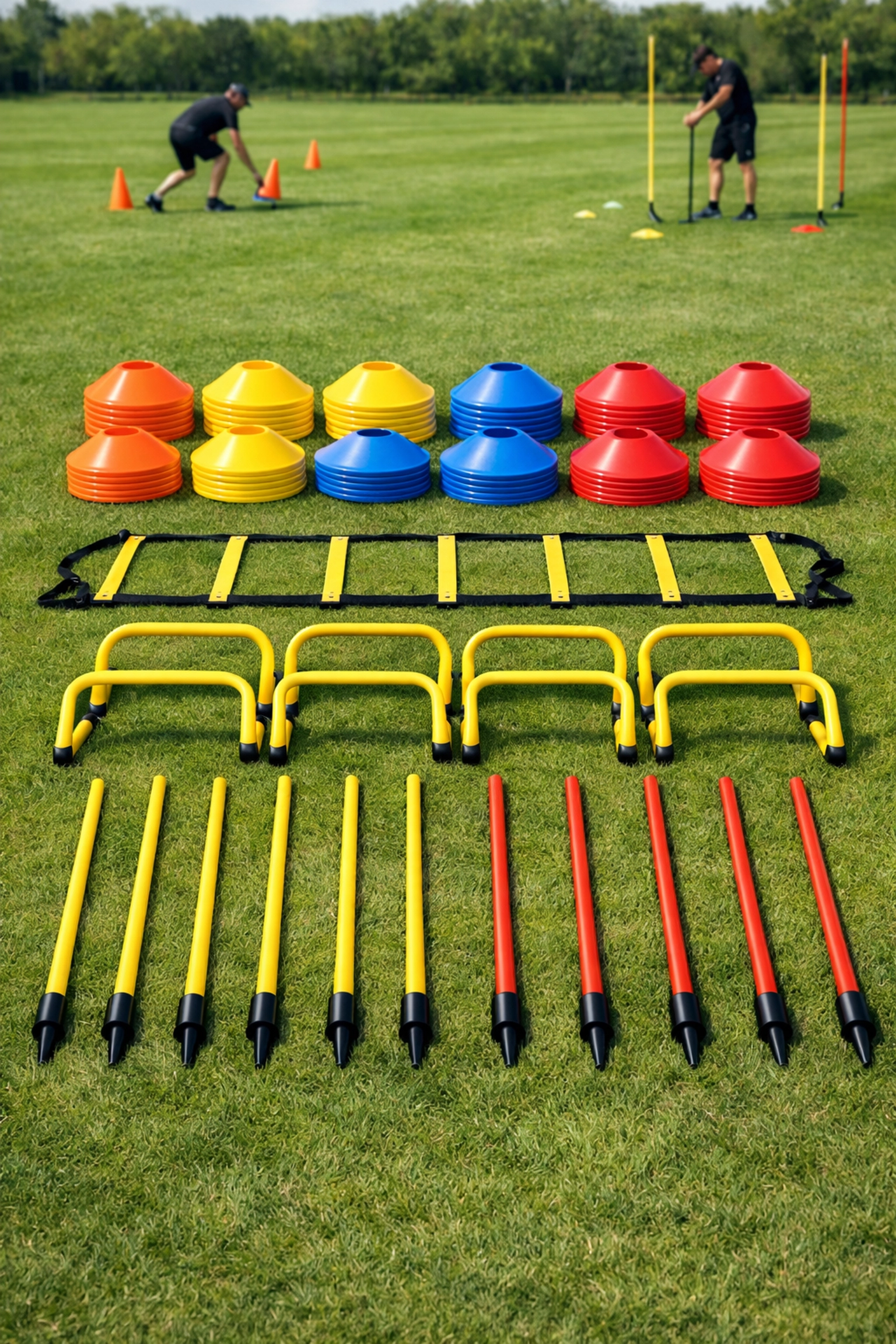
- Agility cones (12-20 cones minimum)
- Speed hurdles (6-inch height works for most athletes)
- Agility ladder (15-20 feet long)
- Speed and agility poles (collapsible for easy transport)
For Reactive Training:
- Colored cones or markers (at least 3 different colors)
- Reaction balls (unpredictable bounce patterns)
- Resistance bands for partner work
- Whistle or visual signal system
You can check out agility training equipment that's designed to handle repeated use without breaking down mid-season.
Pro tip: Buy equipment that does double-duty. Cones work for both planned patterns AND reactive calls. Hurdles can be fixed obstacles or reaction triggers. Keep it simple.
Building Your Weekly Training Mix
Alright, let's get practical. Here's how to structure your week to maximize match readiness:
Foundation Phase (Weeks 1-4):
- 2 sessions of planned drills (20-30 minutes)
- 1 session of reactive work (15-20 minutes)
- Focus on building proper mechanics first
Development Phase (Weeks 5-8):
- 1-2 sessions of planned drills (15-20 minutes)
- 2 sessions of reactive training (20-25 minutes)
- Increase complexity and decision-making demands
Competition Phase (In-season):
- 1 session of planned drills (maintenance, 10-15 minutes)
- 2-3 sessions of reactive work (integrated into practice)
- Focus heavily on game-realistic scenarios
Sample Session Structure:
Warm-up (5 minutes):
- Dynamic stretching through a planned ladder sequence
Planned Block (10-15 minutes):
- 3 sets of zigzag cone runs
- 2 sets of 5-10-5 shuttles
- Rest 45-60 seconds between sets
Reactive Block (15-20 minutes):
- Partner mirror drills (3 minutes × 3 rounds)
- Color-call cone sprints (8-10 reps)
- Small-sided game with constraints (5-7 minutes)
Common Mistakes Coaches Make
Mistake #1: Running only planned drills because they're easier to organize
Yes, setting up a fixed cone pattern is simpler than creating reactive scenarios. But you're leaving your team unprepared for the chaos of competition. Aim for at least 40% reactive work during your training blocks.
Mistake #2: Making reactive drills too complicated too soon
If your athletes are stumbling through basic planned patterns, they're not ready for complex reactive work. Build the foundation first.
Mistake #3: Using the same drills every single session
Variety matters. Rotate through different patterns, distances, and reaction triggers to prevent mental staleness and physical plateaus.
Mistake #4: Forgetting to measure progress
Time your drills. Track decision speed. Note improvements. What gets measured gets improved.
Mistake #5: Neglecting recovery between high-intensity agility work
Agility training is neurologically demanding. If athletes are sloppy, they need more rest between reps. Quality over quantity always wins.
Signs Your Training Is Working
You'll know your mix is right when you see:
✅ Athletes anticipating movements better during scrimmages
✅ Faster change-of-direction times on timed tests
✅ Improved decision-making under pressure
✅ Better body control during cuts and stops
✅ Increased confidence in 1-v-1 situations
✅ Fewer unnecessary movements (more efficient)
Red flag: If athletes look fast in drills but hesitant in matches, you need more reactive work.
Real Talk: What "Match-Ready" Actually Means
Let's be honest: match-ready isn't just about physical speed. It's about:
- Reading the game quickly
- Making good decisions under fatigue
- Adapting to unpredictable situations
- Executing skills automatically (without thinking)
Planned drills build the engine. Reactive training teaches your athletes how to drive it in traffic.
The fastest path to match readiness? Use planned drills to develop the physical qualities, then stress-test those qualities with reactive scenarios that mirror competition.
Your Next Steps
If you're looking to upgrade your team's agility training right now:
-
Assess your current split: Are you running 80% planned drills? Flip it.
-
Invest in versatile equipment: Start with quality cones, a ladder, and hurdles from a reliable source like team training equipment.
-
Plan your next 8-week block: Use the framework above as your template.
-
Add one reactive element to every session: Even a simple color-call drill at the end makes a difference.
-
Track progress weekly: Time your athletes. Write it down. Celebrate improvements.
The debate between reactive and planned agility training isn't really a debate at all: it's a partnership. Use both, balance them intelligently based on your season phase, and watch your team's match performance improve faster than you'd expect.
Your athletes won't thank you for the extra decision-making drills during practice, but they'll thank you when they're beating opponents to loose balls and cutting on a dime during matches. And that's what we're here for, right?
