

If you are serious about speed training rugby, you need more than just running hard: you need a structured system that mirrors how elite sevens stars like Carlin Isles and Dan Norton train. By the end of this guide, you will have a complete, actionable system to increase your sprint speed, acceleration, and game-specific pace, backed by elite examples and UK coaching standards. We cover the mechanics of speed, including acceleration versus top-end speed, specific drills for forwards and backs, how to test and benchmark progress, and how to programme speed work without sacrificing recovery or increasing injury risk.
Table of Contents
- Why Speed Wins Rugby Matches in 2026
- The Science of Rugby Speed: Acceleration vs. Top-End Speed
- Position-Specific Speed Training: Forwards vs. Backs
- How to Test Your Speed: Benchmarks and Tracking
- The 4-Step Speed Training System (With Drills)
- Programming Speed Training for the Season
- Nutrition, Recovery, and the Mental Side of Speed
- Frequently Asked Questions About Speed Training for Rugby
- Summary: Your Next Steps to Get Faster
Why Speed Wins Rugby Matches in 2026
The modern game, across both XVs and Sevens, demands higher work rates and faster line speed than ever before. Defensive systems now rely on rapid up-and-in pressure, while attack thrives on exploiting the tiniest gaps before they close. The elite benchmarks tell a clear story: to play on the men’s World Series, players need to run over 9 metres per second, and for women’s, over 8 metres per second. Stars like Madison Levi exceed 9.4 metres per second, while Carlin Isles has clocked a 10.13-second 100 metres and Dan Norton has scored over 350 tries on the World Series, both regularly hitting speeds above 11 metres per second.
Speed is not just for wingers. Forwards need explosive acceleration for collisions, breakdown arrivals, and that crucial first step off the scrum or lineout. A prop who can accelerate over 5 metres faster than their opposite number wins the contact zone before it begins. Crucially, speed training also reduces hamstring injury risk when programmed correctly, a point the top coaches treat as non-negotiable.
The Science of Rugby Speed: Acceleration vs. Top-End Speed
Why Acceleration Matters More for Most Players
Most rugby sprints are under 20 to 30 metres. Acceleration, specifically the first 5 to 10 metres, wins the contact zone, secures support lines, and beats the first defender. The key mechanics involve a pronounced forward lean of approximately 45 degrees, a piston-like leg drive where the foot strikes directly beneath the hip, and a stiff ankle for what coaches call the “hammer foot” strike. This short, punchy ground contact minimises braking forces and maximises forward propulsion.

Effective drills for acceleration include wall pushes, where you hold the 45-degree lean against a wall for three seconds before driving into a sprint, falling starts that force the body into the correct angle, and resisted sled sprints using a light load. The focus is always on quality over quantity, with full recovery between reps to maintain technical precision.
Building Top-End Speed for Breakaways and Chases
Top speed becomes critical for wingers, fullbacks, and anyone chasing kicks or making line breaks. Once upright, the mechanics shift to a tall posture, high knee drive, and full hip extension. The foot strikes the ground directly beneath the centre of mass, and the arms drive powerfully from the shoulders to counterbalance leg turnover.
Drills for top-end speed include flying 30-metre sprints, where you build into the sprint over 20 metres before hitting maximum velocity, A-skips that transition into a full sprint, and downhill sprints on a gentle gradient to encourage faster limb turnover. These sessions demand even longer rest periods, typically three to four minutes between efforts, to ensure the central nervous system is fully recovered.
Position-Specific Speed Training: Forwards vs. Backs
Speed training rugby programmes often treat all players the same, but forwards and backs have fundamentally different movement demands. Tailoring your approach to your position group yields far better results.
Forwards, including props, hookers, locks, and flankers, need explosive first-step power and the ability to repeat short bursts with minimal drop-off. Training should focus on 5 to 10-metre accelerations, heavy resisted starts with a moderate sled load, and change of direction work that mimics rucking and mauling scenarios. Plyometric exercises like box jumps and broad jumps build the raw power needed for scrum engagement and lineout lifting. The emphasis is on horizontal force production and the ability to win collisions through superior momentum.
Backs, from scrum-halves to fullbacks, require a blend of top-end speed, deceleration control for stepping and swerving, and the capacity to perform repeated high-speed efforts across a match. Flying 40-metre sprints develop maximum velocity, while zig-zag cone drills and depth jumps train reactive agility and braking mechanics. A scrum-half accelerating from the base or a winger chasing a cross-field kick both need the ability to hit top speed and adjust their line without losing pace.
For female players, the principles remain identical, but volume and intensity should be adjusted to individual fitness levels, as the IRFU guidance emphasises. Madison Levi’s 9.4 metres per second benchmark shows what is possible, and female players should use the same drill progressions while listening to their body’s recovery signals.
How to Test Your Speed: Benchmarks and Tracking
Most amateur players never measure their speed, which means they never know if their training is working. Simple field tests remove the guesswork. Start with a 10-metre fly, which measures pure acceleration, and a 40-metre sprint from a standing start, which captures both acceleration and top-end transition. For match-specific conditioning, add a repeated sprint ability test: six 30-metre sprints with 30 seconds of rest between each, recording the drop-off from your fastest to slowest time.
To calculate your speed in metres per second, divide the distance by your time. A 40-metre sprint completed in 5.0 seconds gives you 8 metres per second, a solid amateur benchmark. Elite men hit 9 metres per second and above, while elite women exceed 8 metres per second. Use a stopwatch, a free phone app, or ideally a training partner for accuracy. Clubs with larger budgets may invest in timing gates or GPS vests, but a consistent manual method still tracks progress effectively. Log your results monthly and watch the trend line.
The 4-Step Speed Training System (With Drills)
This system, drawn from the proven methods used by elite sevens coaches and refined for club players, gives you a complete session structure. Each step builds on the last, and skipping steps compromises both performance and safety.
Step 1: Dynamic Warm-Up and Activation
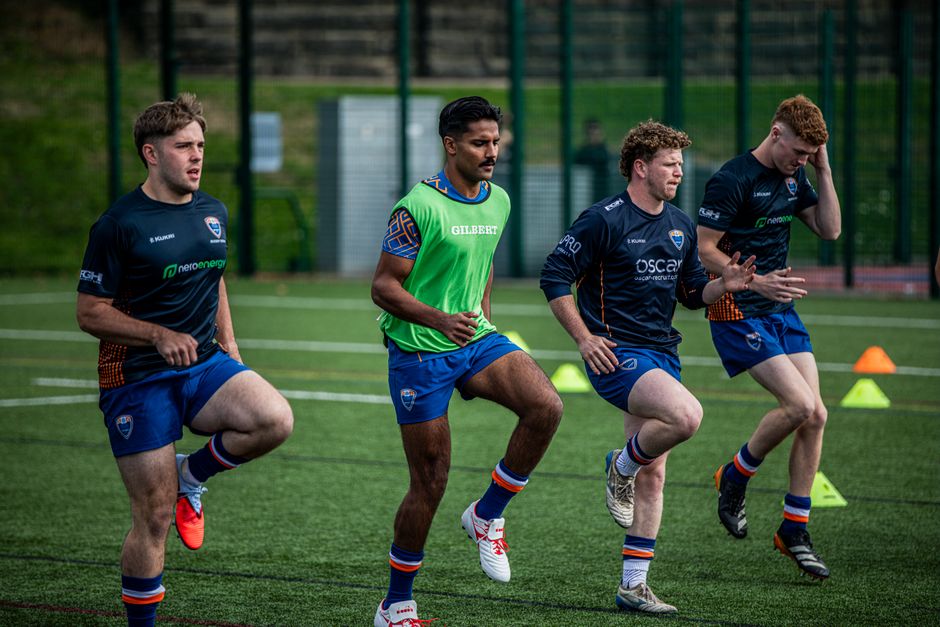
Spend five to ten minutes preparing the body for high-intensity work. Begin with leg swings forward and laterally, walking lunges with a torso twist, high knees, butt kicks, and karaoke drills to open the hips. Follow this with agility ladder drills: single-leg runs, two-feet-in, and lateral shuffles. The purpose is to activate the glutes, hamstrings, and hip flexors while raising core temperature. A thorough warm-up is your first line of defence against hamstring strains.
Step 2: Acceleration Mechanics (0–15m)
This phase develops your ability to cover the first 15 metres with maximum intent. Wall lean starts are foundational: lean into a wall at 45 degrees, drive one knee high, hold for three seconds, then explode into a 10-metre sprint. A-skips into acceleration teach the piston-like leg action, while resisted sprints with a partner holding a light band or harness add overload. Complete four to six reps of 10 to 15 metres, with a full two to three minutes of rest between each. You should feel powerful, not fatigued.
Step 3: Top-End Speed Mechanics (15–40m)
Here, the focus shifts to maximum velocity. Flying 30-metre sprints are the gold standard: build into the sprint over 20 metres, then hold full speed through the 30-metre zone. Practice the hammer foot strike on grass, feeling for a stiff ankle and a quick ground contact. High knee runs that transition into a full sprint help groove the upright posture and arm drive. Complete three to five reps of 30 to 40 metres, with three to four minutes of rest. If your times drop, the session is over.
Step 4: Deceleration and Change of Direction
Rugby is not a straight-line sport. The ability to brake hard and cut laterally separates good attackers from great ones and prevents the injuries that occur when players try to change direction without control. The 5-10-5 shuttle, also called the pro agility test, develops rapid deceleration and reacceleration. The T-drill adds multi-directional movement, and sprint-to-stop drills with an immediate lateral cut train braking mechanics under game-like conditions. Keep a low centre of gravity during the cut and focus on absorbing force through the hips and knees rather than planting hard on a straight leg.
Programming Speed Training for the Season
How you schedule speed work determines whether you peak on match day or burn out by November. During the off-season, train speed twice per week with a heavy focus on mechanics and moderate volume. This is the time to groove technique and build a foundation. Pre-season shifts to two sessions per week mixing acceleration and top-end work, increasing intensity as match fitness improves. In-season, drop to one session per week for maintenance, using game-specific bursts and ensuring you arrive at the weekend fresh.
Rest is the non-negotiable element. Speed work must be done when the central nervous system is fresh, never after a heavy leg day or a gruelling conditioning session. World Rugby Passport guidance reinforces this: full recovery between reps and between sessions is what drives adaptation. If you are still sore from Tuesday’s gym session, delay Friday’s speed work. The quality of each rep matters more than the quantity.
Nutrition, Recovery, and the Mental Side of Speed
Speed training rugby programmes rarely address the supporting factors, yet these are often where the biggest gains hide. Nutritionally, prioritise protein for muscle repair after sessions, aiming for a serving within two hours of finishing. Carbohydrates fuel explosive efforts, so do not fear them around training. Hydration directly affects muscle contraction speed; even mild dehydration slows you down. Some players benefit from creatine supplementation for repeated sprint performance, though whole foods should form the foundation.
Recovery means more than a day off. Aim for eight or more hours of sleep, as this is when the nervous system repairs and movement patterns consolidate. Active recovery, such as light cycling or swimming, flushes soreness without adding load. Hamstring-specific stretching and foam rolling should be daily habits, not just post-session afterthoughts.
The mental side is equally important. Visualisation of explosive starts, where you mentally rehearse the gunshot reaction and the first three strides, primes the nervous system. Reaction drills, such as partner clap sprints where you respond to an auditory cue, sharpen your ability to read and react on the pitch. Decision-making under fatigue can be trained by combining a sprint with an immediate visual cue, such as a coach pointing left or right, forcing you to process information at speed.
Frequently Asked Questions About Speed Training for Rugby
How fast should a rugby player be? Elite men hit 9 metres per second and above; elite women exceed 8 metres per second. For amateur players, a realistic and strong target is 7 to 8 metres per second, depending on position and age.
Can forwards really get faster? Yes. Focused acceleration work combined with strength training, particularly squats, deadlifts, and plyometrics, produces measurable gains. A tighthead prop who improves their first three steps changes their game.
How many times a week should I do speed training? One to two sessions per week, always when fresh. Quality trumps frequency every time.
What is the best drill for top speed? Flying 30-metre sprints with full recovery. Nothing replicates maximum velocity work better.
Does speed training prevent injuries? Yes, when combined with a proper warm-up and hamstring strengthening. The eccentric loading of sprinting, done correctly, builds resilient hamstrings.
Summary: Your Next Steps to Get Faster
The 4-step system, warm-up, acceleration, top-end speed, and deceleration, gives you a complete framework. Start by testing your current 10-metre and 40-metre times, then pick one drill from each step and commit to one session per week. Track your times monthly and adjust as you progress. Speed is trainable at any age and any position, but it rewards consistency and patience. Bookmark this guide, share it with your teammates, and start tracking your times today.


