

If you've been wondering whether those classic speed drills from high school are outdated, you're not alone. With all the flashy tech gadgets and AI-powered speed training programs flooding social media, it's easy to think traditional speed and agility drills have gone the way of the flip phone.
Here's the truth that might surprise you: Traditional speed drills and agility training aren't dead: they're more important than ever. But how smart athletes use them in 2025 has completely transformed, especially around acceleration mechanics, quickness, and change-of-direction work.
The Cold Hard Facts About Speed Drills and Agility Training
Let's cut through the noise with some reality. According to elite performance coaches, there isn't a single elite sprinter who hasn't logged thousands of hours doing speed and acceleration drills. When executed properly, sprint mechanics work and SAQ (speed, agility, quickness) drills will absolutely make you faster and more agile—no exceptions.
But here's where most people get it wrong: they think drills alone will transform them into speed demons. That's like expecting to become a chef by only practicing knife cuts. The technique matters, but it's just one ingredient in the speed training recipe alongside strength, power, and agility conditioning.
What Actually Changed in 2025 for Speed Training
The evolution isn't about throwing out the old playbook: it's about getting smarter with how we use it. Modern athletes have figured out that speed development works like building a house: you need a solid foundation (drills and sprint technique), strong framework (strength and power training), and finishing touches (sport-specific practice, agility/change-of-direction patterns).
The Integration Revolution (SAQ: Speed, Agility, Quickness)
Smart athletes in 2025 don't do isolated training sessions. Instead, they've embraced what sports scientists call "concurrent training": combining acceleration work, agility/change-of-direction, plyometrics, and strength in each workout for maximum carry-over to game-speed performance.
Here's what a typical modern speed and agility session looks like:
Phase 1: Neural Activation (5-8 minutes)
- Dynamic warm-up with movement prep for sprint mechanics and agility
- Light plyometric exercises (hops, bounds) to prime acceleration
- Basic coordination drills and footwork patterns
Phase 2: Technical Development (10-15 minutes)
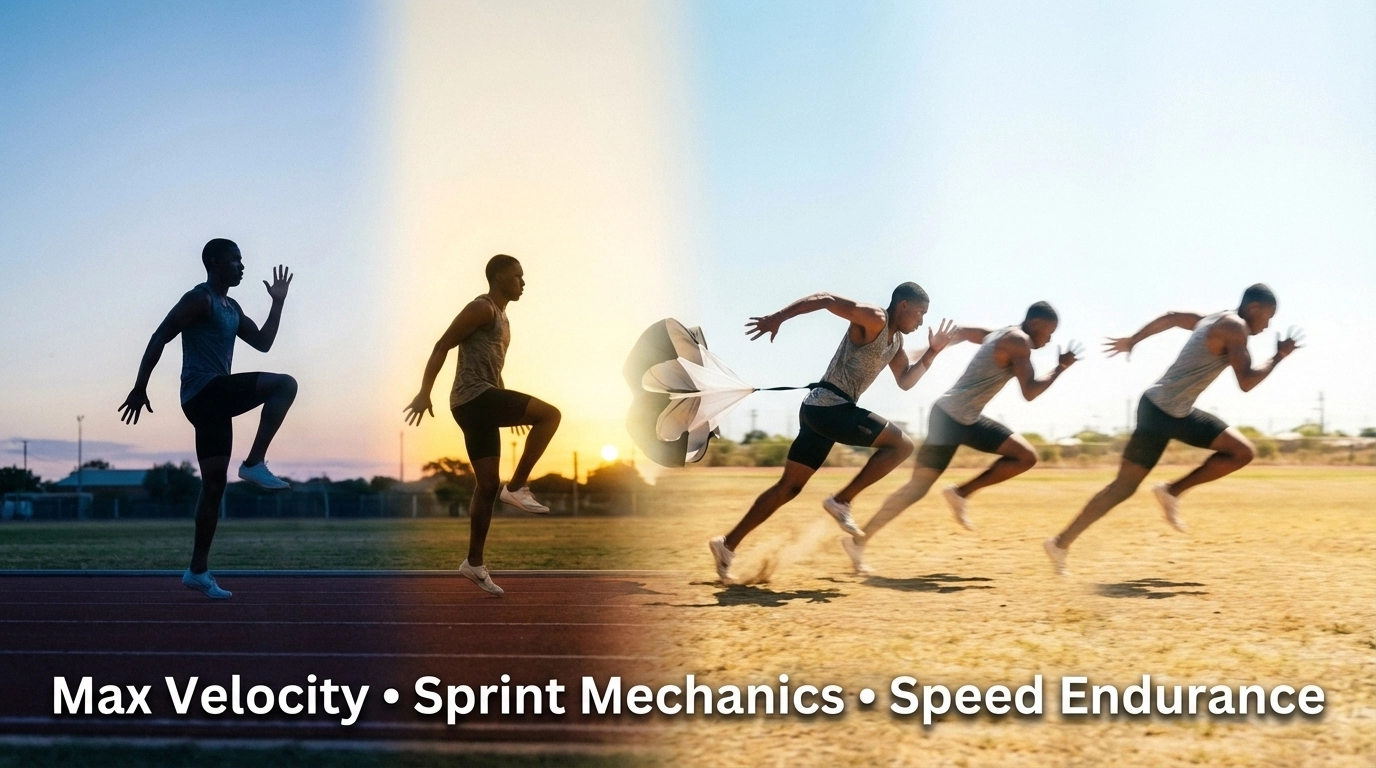
- Traditional speed drills with perfect form (A-skips, high knees, ankling)
- 3-4 different drill types targeting stride frequency and ground contact
- Full recovery between sets to protect neuromuscular speed quality
Phase 3: Applied Speed (15-20 minutes)
- Resisted sprints with equipment like speed chutes or sled pushes/pulls
- Maximum velocity sprints and acceleration reps (10-30 meters)
- Sport-specific speed and agility patterns (change-of-direction, reaction drills)
Phase 4: Recovery and Integration (5-10 minutes)
- Light movement, mobility, and stretching for post-sprint recovery
- Visualization of perfect technique and efficient sprint mechanics

The Core Drills That Still Rule in 2025 for Speed & Agility
Despite all the innovation, certain drills remain non-negotiable for serious athletes. These aren't your grandmother's calisthenics: when done with precision and purpose, they're engineering your nervous system for speed, acceleration, and agility.
1. A-Skip Progressions
What it does: Develops hip flexor strength, stride frequency, and ground contact timing for acceleration mechanics and sprint technique
Modern twist: Athletes now use tempo variations (slow-to-fast progressions) and add resistance bands for overload
How to execute:
- Drive knee to 90 degrees
- Keep ankle dorsiflexed (toe up)
- Focus on quick ground contact
- Maintain tall posture
- Progress from marching to skipping to running rhythm
2. High Knee Marches and Runs
What it does: Builds hip flexor power and teaches proper knee drive mechanics for sprint mechanics and quickness
Modern application: Combined with reaction training, cone cues, and agility ladder patterns
Progression sequence:
- Stationary high knee marches (20 seconds)
- Walking high knees (10 meters)
- Jogging high knees (20 meters)
- Running high knees (30 meters)
3. Butt Kicks with Purpose
What it does: Improves hamstring flexibility and teaches quick heel recovery for a faster leg recovery cycle and turnover speed
2025 upgrade: Athletes now focus on forward lean and gradual acceleration/max velocity transition rather than just getting heels to glutes
4. Straight Leg Bounds
What it does: Develops posterior chain power, horizontal force production, and stride length
Key focus: Landing mechanics, stiffness, and force absorption—not just distance

The Technology Integration That Actually Works for Speed & Agility
While traditional drills form the foundation, smart athletes are strategically incorporating technology to accelerate their progress. But they're not falling for every shiny gadget: they're choosing tools that enhance rather than replace fundamental training.
Timing Gates and Sprint Timing Apps
Modern athletes use timing technology to track their drill progression. When you can measure that your acceleration improved by 0.2 seconds over 20 meters—or your 5-10-5 agility test dropped by a few tenths—you stay motivated and can adjust training loads accordingly.
Video Analysis for Sprint Mechanics and Agility
Slow-motion video helps athletes see what their body is actually doing versus what they think they're doing. Many discover they're not driving their knees as high as they thought, their arm action is off, or their ground contact is too long—plus they can assess change-of-direction angles.
Resistance Training Tools
Speed parachutes and sleds aren't new, but how athletes use them has evolved. Instead of random "harder is better" approaches, smart athletes use specific resistance percentages (typically 5-15% of body weight) for targeted adaptations with sled pushes/pulls, parachute sprints, hill sprints, and band-resisted accelerations.
Common Speed Training Mistakes That Kill Your Progress
Even with perfect drills, most athletes sabotage their speed development with these critical errors:
Mistake 1: Treating Drills Like Cardio
The problem: Doing speed and agility drills when fatigued teaches your nervous system slow, sloppy movement patterns
The fix: Always do speed/SAQ work when fresh, typically early in workouts
Mistake 2: Neglecting Recovery
The reality: Your body adapts during recovery, not during training
The solution: Allow 48-72 hours between intense sprint sessions to protect the CNS and maintain quality
Mistake 3: Forgetting the "Why"
The issue: Going through motions without understanding purpose
The answer: Each drill should have a specific technical focus: knee drive, ground contact, arm action, posture, stride frequency, and change-of-direction angles
Mistake 4: Avoiding Actual Sprinting
The truth: Drills prepare you for speed, but you must also practice sprinting at maximum velocity
The balance: 70% drills and technique work, 30% maximum velocity and acceleration/speed endurance practice
Building Your 2025 Speed & Agility Training Program
Ready to put this into practice? Here's a framework that scales from beginner to advanced:
Week 1-2: Foundation Phase
Frequency: 2 sessions per week
Focus: Perfect technique, build movement patterns (sprint mechanics, footwork, agility)
Volume: 3-4 drills, 4 sets of 10-20 meters each
Week 3-4: Development Phase
Frequency: 3 sessions per week
Focus: Increase speed, acceleration, and distance
Volume: 4-5 drills, 5 sets of 20-30 meters each
Week 5-6: Integration Phase
Frequency: 3-4 sessions per week
Focus: Combine drills with sprints, agility/COD work, and resistance work
Volume: Full integrated sessions as outlined above
Ongoing: Maintenance and Progression
Frequency: 3 sessions per week
Focus: Maintain technique while progressively increasing challenge (quickness, stride frequency, change-of-direction)
Volume: Varies based on sport season and competition schedule
The Science Behind Why This Works
Modern research has confirmed what elite coaches knew intuitively: speed development requires both technical precision and physical preparation. Drills improve your movement efficiency—teaching sprint mechanics, posture, and stride frequency—essentially teaching your body to waste less energy with each step. Meanwhile, strength and power training boosts rate of force development and horizontal force for better acceleration.
The magic happens when these elements combine. A technically efficient runner who can also produce massive ground reaction forces and maintain stiffness becomes unstoppable in both straight-line speed and agility. It's like having a perfectly tuned race car with a powerful engine.
Your Next Steps to Getting Faster
Don't let analysis paralysis keep you slow. Here's your action plan:
This week:
- Choose 3 basic drills (A-skips, high knees, butt kicks) for sprint mechanics
- Practice them for 10 minutes, 2 times, focusing on acceleration and quickness
- Focus purely on technique: film yourself to assess knee drive, posture, and ground contact
Next week:
- Add straight leg bounds and increase sessions to 3, plus 1 agility/COD block
- Begin tracking your times over 20-meter sprints and a 5-10-5 agility test
- Explore resistance training tools to add variety (sled pushes, parachute sprints, hill sprints)
Month 2:
- Implement full integrated sessions (acceleration, max velocity, agility, plyometrics)
- Track progress with simple metrics (sprint times, agility tests, jump distances)
- Adjust training loads based on what's working to keep speed quality high
Remember, speed development is a marathon, not a sprint (pun intended). Those elite athletes didn't get fast overnight, and neither will you. But with consistent, intelligent training that respects both tradition and innovation, you'll be amazed at what your body can achieve.
The drills that worked for Olympic champions 20 years ago still work today: we're just smarter about how we use them. So lace up those spikes, grab your speed and agility training equipment, and start building the speed, acceleration, and quickness you've always wanted. Your fastest self is waiting.


