

If you're new to speed training, you're not alone in feeling overwhelmed by expensive equipment and complicated routines. The truth? You can build impressive speed without emptying your wallet or needing a fancy gym membership. Whether you're looking to dominate your weekend soccer league or just want to feel faster and more athletic, this guide will show you exactly how to get started.
Why Speed Training Matters (And Why You Can Afford It)
Speed isn't just for elite athletes – it's a fundamental skill that improves your performance in any sport while boosting your confidence. The best part? Most effective speed training happens with minimal equipment. Your body, some open space, and maybe a few basic tools are all you need to see real improvements in just 4-6 weeks.
What you'll gain from consistent speed training:
• Faster sprint times (expect to shave 0.2-0.5 seconds off your 40-yard dash)
• Better agility and reaction time
• Increased power and explosiveness
• Reduced injury risk through improved movement patterns
• Enhanced athletic confidence

The Foundation: Master These Basics First
Before diving into drills and workouts, you need to nail the fundamentals. Think of these as your speed training alphabet – master them, and everything else becomes easier.
1. Perfect Your Running Form
Good form is free speed. Focus on these key elements during every training session:
Arm Drive: Keep your arms at 90 degrees, drive your elbows back (not across your body), and maintain relaxed shoulders. Your arms should pump like pistons – smooth and powerful.
Posture: Run tall with a slight forward lean from your ankles, not your waist. Imagine a string pulling you up from the crown of your head.
Foot Strike: Land on the balls of your feet directly under your center of gravity. Avoid overstriding, which acts like a brake with every step.
2. Warm Up Like a Pro
Never skip your warm-up – it's your injury insurance policy. Spend 10-15 minutes preparing your body with this simple routine:
• 5 minutes of light jogging
• Leg swings (forward/back and side to side) – 10 each direction
• High knees – 2 sets of 15 meters
• Butt kicks – 2 sets of 15 meters
• A-skips – 2 sets of 15 meters
• Dynamic lunges – 10 each leg
3. Start Smart with Recovery
Your muscles get faster during recovery, not during training. As a beginner, limit speed work to 2-3 times per week with at least 48 hours between intense sessions. Quality beats quantity every time.
Budget-Friendly Speed Workouts That Actually Work
Here are five proven workout types that require minimal to no equipment. Start with one type per week, then gradually incorporate others as you build fitness.
1. Hill Sprints: Nature's Speed Machine
Hills are your secret weapon for building speed on a budget. They force proper form, build leg strength, and reduce injury risk by naturally limiting your top speed.
How to do it:
• Find a hill with a 6-8% grade (steep enough to challenge you, not so steep you're crawling)
• Sprint uphill for 10-15 seconds at 90% effort
• Walk slowly back down for full recovery (2-3 minutes)
• Start with 4-6 repetitions, build to 8-10 over 4 weeks
Pro tip: Focus on driving your knees up and pumping your arms. The hill will teach your body the correct sprint mechanics naturally.

2. Strides: The Gentle Giant of Speed Work
Strides are like speed training with training wheels – they teach your body to move fast without the stress of all-out sprinting.
The technique:
• At the end of an easy run, find a flat 100-meter stretch
• Gradually accelerate for 20 meters
• Hold top speed for 40-60 meters (about 85% effort)
• Gradually decelerate for 20 meters
• Walk back for complete recovery
Weekly plan: Start with 4 strides once per week, progress to 6-8 strides twice per week after a month.
3. Fartlek Training: Swedish for "Speed Play"
Fartlek is unstructured speed work that makes training fun and builds both speed and endurance. Think of it as adult tag with yourself.
Sample fartlek workout:
• 10-minute easy jog warm-up
• Sprint to the next mailbox, jog to the corner
• Fast run for 1 minute, easy jog for 2 minutes
• Sprint up the next hill, walk down
• Continue for 15-20 minutes total
• 5-minute cool-down jog
This type of training costs nothing but gives you real-world speed that transfers to sports.
4. Track Intervals: Structured Speed Building
If you have access to a track (most high schools open theirs to the public), intervals are incredibly effective for building speed endurance.
Beginner interval progression:
Week 1-2: 4 x 200 meters at 85% effort, 2-minute walking recovery
Week 3-4: 6 x 200 meters at 85% effort, 90-second jogging recovery
Week 5-6: 4 x 400 meters at 80% effort, 3-minute walking recovery
5. Acceleration Drills: Building Explosive Starts
Your first 10 steps determine everything. These drills teach you to explode from a standstill without needing a starting line.
Wall starts: Stand arm's length from a wall, lean forward until your hands touch it. Fall forward and catch yourself by sprinting for 10 yards. This teaches proper acceleration angles.
3-point starts: Get in a sprinter's stance (like football), drive with the outside leg first, pump your arms, and accelerate for 20 yards.
Strength Training on a Shoestring Budget
Speed without strength is like a sports car with a lawn mower engine. You don't need a gym membership – your bodyweight provides plenty of resistance for beginners.
The Big Four for Speed:
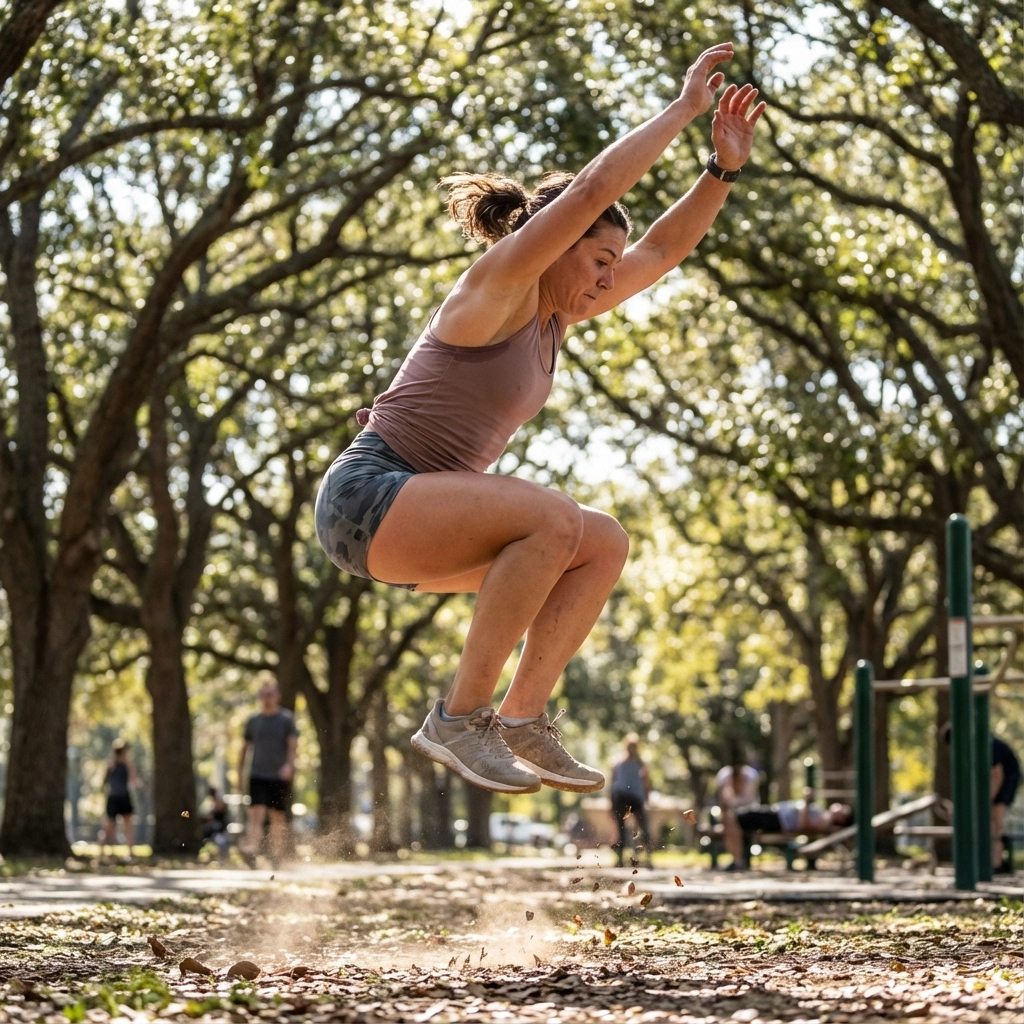
1. Jump Squats: 3 sets of 8-12 reps
• Squat down, explode up as high as possible
• Focus on quick ground contact when landing
2. Single-Leg Bounds: 3 sets of 6 each leg
• Push off one leg, leap forward, land on the same leg
• Think distance and height, not just speed
3. Glute Bridges: 3 sets of 15-20 reps
• Lie on your back, drive through your heels
• Squeeze your glutes hard at the top
4. Lateral Lunges: 3 sets of 10 each direction
• Step wide to one side, sit back into the hip
• Push off and return to center
Perform this routine 2 times per week on non-sprint days.
When to Invest in Simple Equipment
Once you've mastered the basics (after 6-8 weeks), a few affordable tools can take your training to the next level:
Speed ladder ($15-25): Perfect for footwork and coordination. The agility training ladder helps develop quick feet and body control.
Resistance bands ($10-20): Add resistance to your sprints for power development. Start with basic resistance bands for strength exercises.
Training parachute ($20-30): Creates resistance during sprints to build acceleration power. The speed parachute is excellent for intermediate runners.
Your 8-Week Beginner Speed Plan
Here's a simple progression that builds speed safely and systematically:
Weeks 1-2: Foundation Phase
• 2 speed sessions per week
• Focus: Hill sprints (4-6 reps) + bodyweight strength
• Volume: 200-400 meters total sprint distance per session
Weeks 3-4: Development Phase
• 2 speed sessions per week
• Focus: Add strides + increase hill sprint reps (6-8)
• Volume: 400-600 meters total sprint distance per session
Weeks 5-6: Power Phase
• 3 speed sessions per week
• Focus: Track intervals + acceleration drills
• Volume: 600-800 meters total sprint distance per session
Weeks 7-8: Integration Phase
• 3 speed sessions per week
• Focus: Sport-specific drills + maintain fitness
• Volume: 800-1000 meters total sprint distance per session
Common Beginner Mistakes to Avoid
Doing too much, too soon: Your enthusiasm is awesome, but your tendons need time to adapt. Start with shorter distances and build gradually.
Ignoring recovery: If you're sore, tired, or your times are getting slower, take an extra rest day. Speed training when fatigued leads to injury and poor movement patterns.
Comparing yourself to others: Your only competition is yesterday's version of yourself. Focus on your own progress and celebrate small wins.
Skipping the warm-up: Those 10 minutes might feel boring, but they're the difference between getting faster and getting injured.
Track Your Progress Like a Pro
Keep a simple training log to stay motivated and spot patterns:
• Date and workout type
• Total sprint distance
• How you felt (1-10 energy scale)
• Best time for a specific distance
• Weather conditions
Test yourself monthly with a timed 40-yard dash or 100-meter sprint. Even small improvements (0.1-0.2 seconds) represent significant gains in speed.
Ready to Get Started?
Speed training doesn't require a trust fund or professional coaching to be effective. With consistent effort, smart progression, and the budget-friendly methods in this guide, you'll be surprised how much faster you can get in just two months.
Remember: every elite athlete started exactly where you are now. The difference isn't natural talent – it's the commitment to show up consistently and train smart. Your future faster self is waiting for you to take that first step.
Start with one hill sprint workout this week. Your speed journey begins now, and it costs absolutely nothing to begin.


