

If you're looking for one of the simplest yet most effective pieces of training equipment out there, sports cones are hard to beat. Whether you're coaching a youth football squad, training a rugby team, or just working on your own fitness, cones offer endless possibilities for agility work.
The best part? You don't need a fancy setup or expensive gear. A set of cones and a bit of space is all it takes to run drills that genuinely improve speed, coordination, and change of direction.
In this guide, we'll walk you through the ultimate agility drills using sports cones: covering everything from classic setups to sport-specific variations. Let's get into it.
1. Why Sports Cones Are Essential for Agility Training
Before we dive into the drills, let's talk about why cones deserve a permanent spot in your kit bag.
Cones are versatile, portable, and incredibly effective. They work multiple leg and core muscles, challenge your tendons, and help athletes develop the quick footwork needed for almost any sport.
Here's what makes cone drills so valuable:
- Minimal equipment needed – Four cones (or more) and you're set
- Easy to adjust difficulty – Change spacing, add movements, or increase speed
- Transferable skills – Improves performance across football, rugby, basketball, netball, and more
- Low injury risk – When done correctly, cone drills are safe for all ages and levels
The key principle? Maintain a low body position during direction changes. This keeps your centre of gravity stable and allows for explosive acceleration out of each turn.
2. Setting Up Your Training Space
You don't need a full pitch to run effective cone drills. A space of around 10-20 metres is plenty for most setups.
Basic setup tips:
- Use flat ground (grass, turf, or indoor courts all work)
- Space cones 5 yards (about 4.5 metres) apart for standard drills
- Ensure athletes have proper footwear with good grip
- Always warm up before starting: dynamic stretches and light jogging work well
If you're working with a team, consider grabbing a larger cone set like the FH Pro Mini Marker Saucer Cone Set to create multiple stations and keep everyone moving.
3. The T-Drill: Master Sharp Turns and Acceleration
The T-Drill is one of the most popular agility exercises for good reason. It trains forward sprints, lateral shuffles, and quick direction changes: all in one drill.

How to set it up:
- Place one cone as your starting point
- Set a second cone 10 yards directly ahead
- Place two more cones 5 yards to the left and right of the second cone (forming a "T" shape)
How to run it:
- Sprint forward from the starting cone to the middle cone
- Touch the base of the middle cone
- Shuffle left to the far cone: touch it
- Shuffle right all the way across to the opposite cone: touch it
- Shuffle back to the middle cone
- Backpedal to the starting point
Key coaching points:
- Stay low throughout the lateral shuffles
- Don't cross your feet when moving sideways
- Explode out of each direction change
- Aim for 8-12 seconds as a solid benchmark time
This drill is brilliant for sports requiring quick lateral movement: think basketball, tennis, and football defenders.
4. The Box Drill: Build Multi-Directional Speed
Also known as the 4-Corner Drill, this setup is perfect for beginners and can be easily scaled up for more advanced athletes.
How to set it up:
- Place four cones in a square, each 5 yards apart
Basic version:
- Start at cone 1
- Sprint to cone 2
- Shuffle sideways to cone 3
- Backpedal to cone 4
- Shuffle back to cone 1
Variations to try:
- Sprint-Shuffle: Sprint forward, shuffle across, sprint backward, shuffle back
- All Sprints: Sprint the entire square, focusing on sharp 90-degree turns
- Reactive: Have a coach call out directions randomly: athletes must react and move accordingly
The Box Drill strengthens a player's ability to change direction quickly while maintaining balance. It's simple to learn but challenging to master at speed.
5. The 3-Cone Drill (L-Drill): Combine Speed and Precision
This drill is a staple at professional combines for a reason: it packs a lot of movement into a small space.
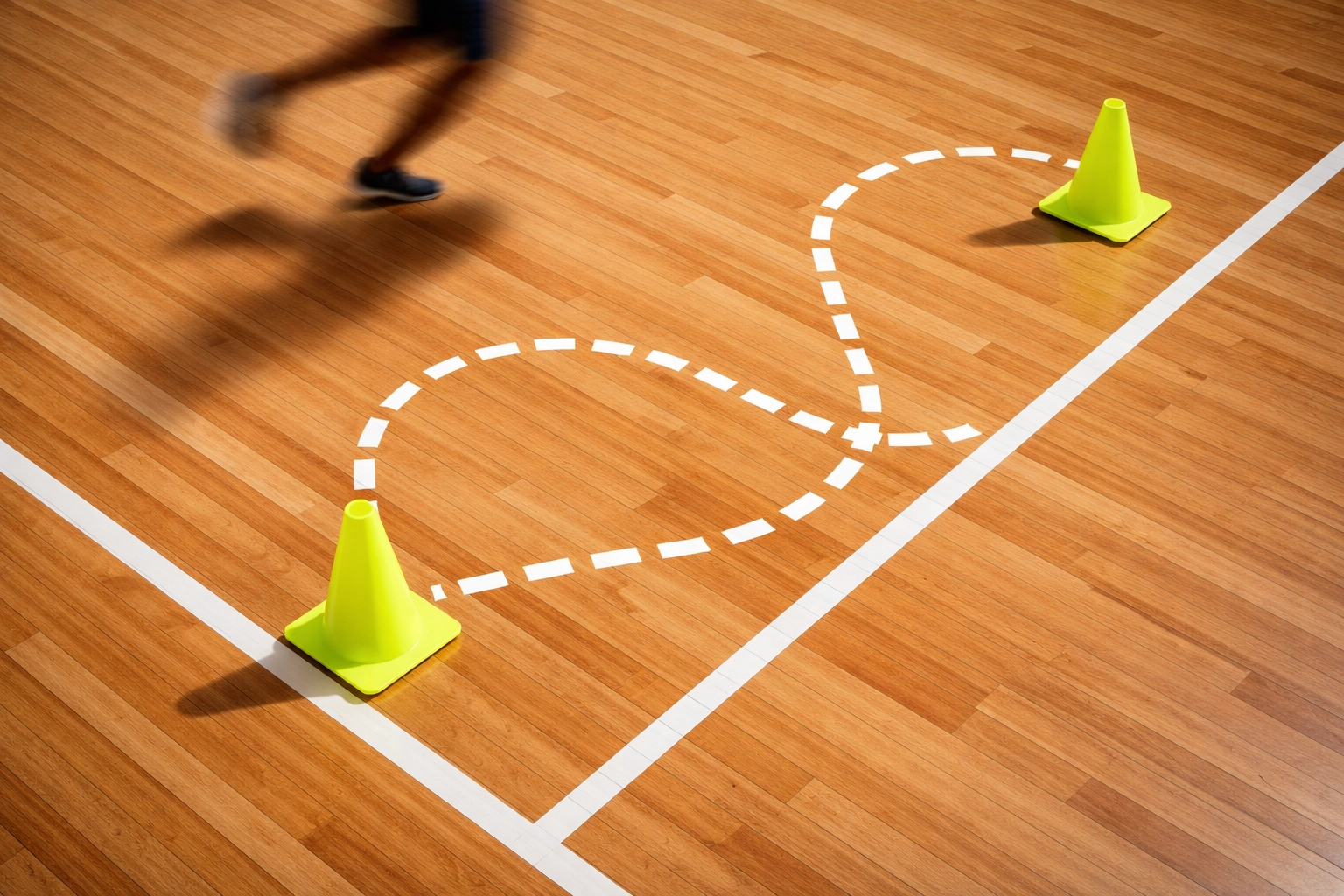
How to set it up:
- Place three cones in an "L" shape, each 5 yards apart
How to run it:
- Start at cone 1
- Sprint to cone 2, touch the ground
- Sprint back to cone 1, touch the ground
- Sprint back to cone 2, then weave around it
- Sprint to cone 3, loop around it
- Weave back around cone 2 and sprint to the finish at cone 1
Why it works:
This drill forces multiple direction changes in quick succession. It builds the explosiveness needed for dodging opponents and reacting to play changes.
6. The Serpentine Run: Improve Diagonal Movement
Many sports require moving at angles rather than straight lines. The Serpentine Run trains exactly that.
How to set it up:
- Place 4-6 cones in a straight line, each 5 yards apart
How to run it:
- Start to the side of the first cone
- Run diagonally to the opposite side of the next cone
- Continue weaving through the line in a snake-like pattern
- Focus on staying balanced while changing angles
This drill improves your ability to stay controlled during diagonal sprints: useful for wingers, midfielders, and anyone who needs to beat a defender.
7. The Cone Weave: Challenge Your Footwork
If you want to level up coordination and close control, the cone weave is your go-to.

How to set it up:
- Place 6-10 cones in a straight line, spaced 2-3 yards apart
How to run it:
- Weave in and out of the cones as quickly as possible
- Stay on your toes and keep your body low
- Use quick, choppy steps rather than long strides
Add a ball:
For football or hockey players, dribble a ball through the cones. This adds a technical element while maintaining the agility focus.
8. Common Mistakes to Avoid
Even simple drills can go wrong if technique is off. Here are some red flags to watch for:
- Standing too tall – Keep your hips low, especially during turns
- Crossing feet on lateral movements – This slows you down and increases injury risk
- Rounding corners – Focus on sharp, decisive direction changes
- Going too fast too soon – Master the movement pattern before adding speed
- Skipping the warm-up – Cold muscles don't move well and are more prone to injury
If you're new to agility training, start slow. Think of drills like learning dance moves: get the steps right first, then add the tempo.
9. How to Build a Complete Cone Training Session
Here's a sample session structure you can use with your team:
| Phase | Activity | Duration |
|---|---|---|
| Warm-up | Dynamic stretches + light jog | 5-10 mins |
| Drill 1 | T-Drill (3-4 reps each) | 5 mins |
| Drill 2 | Box Drill variations | 5 mins |
| Drill 3 | Serpentine Run | 5 mins |
| Drill 4 | Cone Weave (with or without ball) | 5 mins |
| Cool-down | Static stretches | 5 mins |
Aim for 2-3 agility sessions per week, allowing rest days in between for recovery.
10. Take Your Training Further
Sports cones are just the starting point. Once your athletes have nailed the basics, consider adding resistance tools to increase the challenge.
Pair cone drills with a speed training ladder for footwork, or add a resistance harness to build explosive power during sprints.
The key is progression. Start simple, master the movements, then layer in new challenges as athletes improve.
Ready to Get Started?
Sports cones might look basic, but the results they deliver are anything but. With the drills in this guide, you've got everything you need to build sharper turns, faster acceleration, and better overall agility.
Grab your cones, set up your space, and get moving. Your team's performance will thank you.


